Ghee vs Seed Oils: What the Science Actually Says
A 2025 meta-analysis of 18 studies and ~20,000 participants found ghee's link to coronary heart disease modest and non-significant. ICMR-NIN says rotate two or more vegetable oils, minimise ghee, eliminate vanaspati.
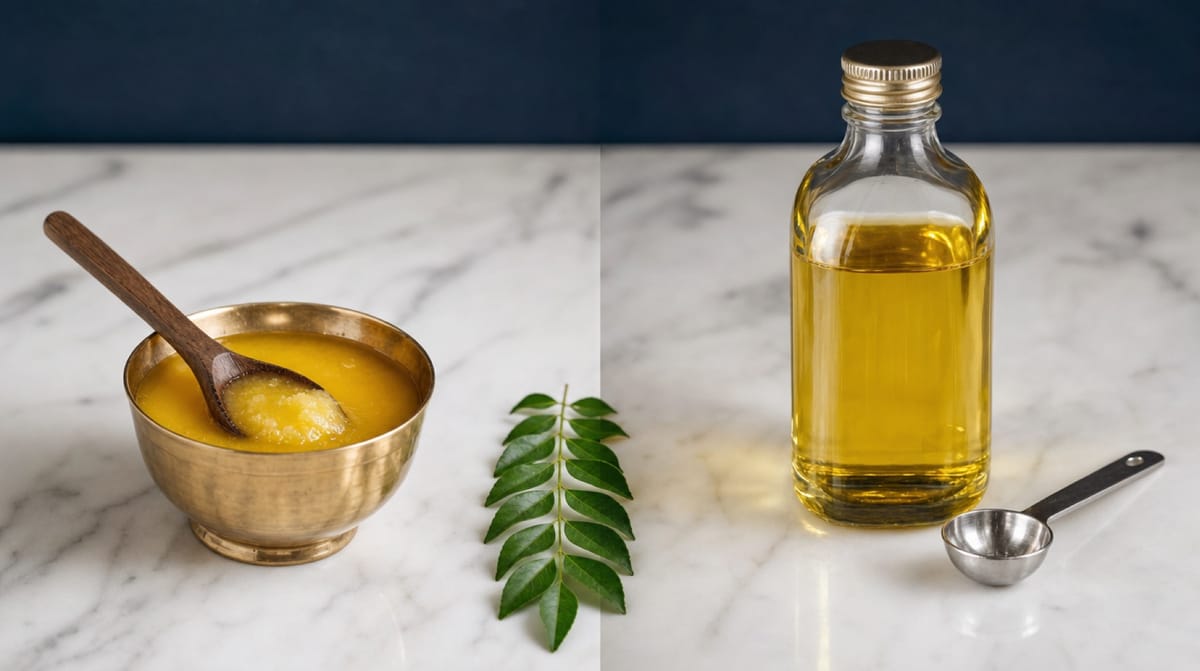
Note: This article is for informational purposes only. If you have established cardiovascular disease, diabetes, or other chronic conditions, discuss your cooking oil choices with your doctor or a qualified dietitian before making significant dietary changes.
Few nutrition debates generate more heat in Indian households and social media feeds than the question of ghee versus seed oils. In one corner: ghee, recast by wellness influencers as an ancient superfood whose traditional use was wrongly maligned by modern nutrition. In the other: seed oils, accused by a vocal and growing online community of being the root cause of cardiovascular disease, inflammation, and a range of modern health crises. Both narratives are more confident than the evidence warrants.
Neither ghee nor seed oils are categorically good or bad for cardiovascular health. The best available evidence shows that the quantity consumed, the degree of processing, the cooking method, and the ratio of fatty acids in the overall diet matter more than which specific oil you use. And India's own regulatory body, ICMR-NIN, points not toward choosing one oil over another but toward rotating two or more vegetable oils and minimising ghee, butter, and vanaspati within a total fat limit of 20 to 50 grams per day. This guide works through what the science actually shows, source by source.
SwasthiQ is building Healthcare Rails for India, the connected ecosystem that links a patient's diet history, lipid profile, and clinical record so a cooking-fat decision made at home is something a cardiologist can see and discuss, not a blind spot in the medical record. Cooking oil choices are not just a kitchen issue; they are a clinical one.
Official sources: Aulesa & Fernandez, Progress in Nutrition, 2025 | Anamika et al., Eastern J Med Sci, 2025 | ICMR-NIN Dietary Guidelines 2024 | ICMR-NIN RDA 2020
What the Science Actually Shows on Ghee and Heart Health
The most rigorous evidence on ghee and cardiovascular disease comes from a systematic review and meta-analysis published in Progress in Nutrition in 2025 by Aulesa and Fernandez of Vall d'Hebron Hospital, Barcelona (DOI: 10.23751/pn.v27i3.16889). The study followed PRISMA 2020 and MOOSE guidelines, screened over 900 studies published between 1994 and 2024, and included 18 studies encompassing nearly 20,000 participants. The pooled analysis found an odds ratio of 1.15 (95% CI: 0.71 to 1.59) for the association between ghee consumption and coronary heart disease. This is a modest, statistically non-significant result. The confidence interval crosses 1.0, meaning the data is consistent with no effect. The authors concluded that ghee intake demonstrated neutral to mildly favourable effects on lipid parameters, and that the evidence supports a balanced approach embracing ghee as a traditional fat within moderation and overall dietary quality.
A separate narrative review by Anamika et al., published in the Eastern Journal of Medical Sciences in August 2025, synthesised current literature on both ghee and seed oils, noting that some studies show ghee may improve HDL levels and reduce LDL oxidation at moderate intake, while seed oils high in omega-6 support endothelial function when consumed in appropriate ratios. This review situates both fats within the broader complexity of dietary fat science rather than declaring either a winner.
A 2022 randomised crossover trial by Mohammadi Hosseinabadi and Nasrollahzadeh, published in the British Journal of Nutrition, compared diets rich in ghee versus olive oil on cardiometabolic risk factors in healthy adults. The trial-level evidence offers more controlled conditions than observational data and supports the position that ghee at moderate intake does not produce the extreme cardiovascular harm that popular narratives suggest.
What the evidence does not show is that ghee is a health food that should be consumed freely or used as a substitute for vegetable oils across all cooking applications. The systematic review's non-significant odds ratio is a nuanced finding, not a green light.
What Ghee Actually Is: Composition and Cooking Properties
Ghee is clarified butter, produced by simmering butter until the milk solids and water separate and are removed, leaving a shelf-stable pure fat. Its fatty acid composition is approximately 65% saturated fat (primarily palmitic, stearic, and myristic acid), 32% monounsaturated fat (primarily oleic acid), and 3% polyunsaturated fat. It contains conjugated linoleic acid (CLA, a fatty acid found in ruminant animal fat that has been associated with anti-inflammatory effects in some research), butyrate (butyric acid, a short-chain fatty acid that serves as a primary fuel for colonocytes, the cells lining the colon), and fat-soluble vitamins A, D, E, and K.
Two properties of ghee are practically relevant. First, it has a high smoke point of approximately 250°C, meaning it can withstand the high temperatures of Indian cooking methods including tempering, deep frying, and tawa cooking without breaking down and producing harmful oxidation products. Second, because the milk solids have been removed, it does not contain lactose, making it tolerable for most people with lactose intolerance who cannot handle butter.
The concern with ghee is its high saturated fat content. The ICMR Dietary Guidelines for Indians specify that saturated fat intake from visible fats should not exceed 10 grams per day, or 5% of total calories for a 2,000-calorie diet. A single tablespoon of ghee (approximately 14 grams) contains roughly 8 to 9 grams of saturated fat, meaning one tablespoon approaches the daily saturated fat limit from visible fats. This is not a prohibition on ghee. It is a calibration of quantity that the traditional use of ghee as a flavouring agent (a small amount on dal, roti, or rice) is consistent with, while the "pile it on because it's traditional" approach is not.
What Seed Oils Are: Types and the Indian Market
"Seed oil" is a broad category covering oils extracted from plant seeds. The seed oils most commonly used in Indian households are refined sunflower oil, refined soybean oil, groundnut (peanut) oil, and mustard oil. These differ substantially in their fatty acid profiles, and treating them as a single category is one of the most misleading aspects of the online seed oil debate.
Refined sunflower oil contains approximately 66% linoleic acid (omega-6 polyunsaturated fat), 23% oleic acid (monounsaturated), and 11% saturated fat. It is the dominant cooking oil in many urban Indian households and in processed food manufacturing.
Mustard oil, used traditionally across North, East, and Central India, contains approximately 60% oleic and erucic acids, 12% alpha-linolenic acid (ALA, an omega-3 fatty acid), 12% linoleic acid (omega-6), and 11% saturated fat. Its ALA content gives it a substantially better omega-6 to omega-3 ratio than refined sunflower oil. However, mustard oil's erucic acid content requires disclosure. Erucic acid (22:1), a long-chain monounsaturated fatty acid, at high doses in animal studies has been associated with myocardial lipidosis (abnormal fat accumulation in heart muscle cells). On this basis, mustard oil is banned for human consumption in the US and EU. FSSAI permits mustard oil in India, where it has been a dietary staple for centuries at typical culinary quantities, and ICMR-NIN includes it among its recommended rotation oils. The current scientific consensus does not establish that erucic acid at typical Indian dietary levels causes cardiovascular harm in humans, but individuals with established heart disease should discuss cooking oil choices with their doctor before making mustard oil a primary cooking fat.
Rice bran oil, increasingly recommended by nutrition scientists, contains approximately 40% oleic acid, 34% linoleic acid, and 20% saturated fat, with a more balanced PUFA profile and bioactive compounds including oryzanol and tocopherols that have been associated with cholesterol-lowering effects.
Refined groundnut (peanut) oil contains approximately 46% oleic, 32% linoleic, and 19% saturated fat, which is a more balanced profile than sunflower oil.
The nutritional profiles of these oils differ enough that the popular narrative treating all seed oils as equivalent (as though cold-pressed mustard oil and industrially refined high-oleic sunflower oil are the same substance with the same health implications) is simply not accurate. ICMR-NIN scientists explicitly state that no single vegetable oil provides all essential fatty acids, which is precisely why the recommendation is to rotate two or more oils rather than rely on one.
The Omega-6 to Omega-3 Ratio: Where a Legitimate Concern Lives
One genuine concern about the current Indian diet's oil composition is the ratio of omega-6 to omega-3 polyunsaturated fatty acids. ICMR-NIN's RDA 2020 recommends a daily intake of 6.6 grams of n-6 PUFA and 2.2 grams of n-3 PUFA (an approximate 3:1 ratio). Based on dietary survey data and the predominance of refined high-omega-6 oils in urban Indian diets, researchers have documented elevated omega-6 to omega-3 ratios in Indian populations that are substantially above the recommended range. A peer-reviewed study from AIIMS Delhi and the South Asia Network for Chronic Disease (Gupta et al., Food and Nutrition Sciences, 2013, PMC5598746) measured serum omega-6 to omega-3 ratios in an urban Indian industrial population and found markedly elevated values, consistent with the documented dietary shift toward refined high-omega-6 oils. A cross-sectional study from Moradabad (Singh et al., MedCrave, 2017) found ratios rising toward 45:1 among South Asians consuming predominantly sunflower, corn, and soybean oil.
This matters because omega-6 and omega-3 fatty acids compete for the same metabolic enzymes. An extreme excess of omega-6 relative to omega-3 may shift the body's eicosanoid (hormone-like signalling molecules derived from fatty acids) balance in a direction that promotes rather than resolves inflammation. This concern is scientifically legitimate and is reflected in ICMR-NIN's recommendation to include ALA-rich oils (mustard oil is the most accessible traditional source) alongside omega-3-rich foods such as flaxseed, chia seeds, walnuts, and fatty fish.
However, this is a concern about the ratio within the diet and the dominance of highly refined omega-6-rich oils, not a condemnation of polyunsaturated fats in general. The WHO, AHA, and ICMR-NIN all maintain (per WHO's 2023 guidelines on saturated and trans-fatty acids and the AHA Presidential Advisory by Sacks et al., Circulation, 2017) that replacing saturated fat with polyunsaturated fat reduces cardiovascular disease risk. The risk identified with the current Indian diet is replacing a diversity of traditional oils with a single refined high-omega-6 oil used in large quantities and repeatedly heated. That is a different claim from "seed oils cause heart disease."
The Reheating Problem: Where Both Sides Have Valid Ground
The most clearly evidence-backed concern about cooking oils in India has nothing to do with which oil you start with. It is what happens to any oil when it is repeatedly heated to high temperatures.
ICMR Dietary Guidelines for Indians explicitly state that "repeated heating of cooking oils and fats should be avoided because reheating of oil results in oxidation of PUFA, leading to harmful compounds or toxins which may increase the risk of cardiovascular diseases and cancer." Oils high in polyunsaturated fat are more susceptible to oxidation at high temperatures than oils high in saturated or monounsaturated fat, because PUFAs have more double bonds that can react with oxygen. Refined sunflower oil, with its high linoleic acid content, oxidises more readily at frying temperatures than mustard oil, rice bran oil, or ghee.
This creates a practical hierarchy for specific applications. For high-temperature cooking (deep frying, tempering, tawa cooking at very high heat), oils and fats with higher heat stability are more appropriate: ghee, refined coconut oil, groundnut oil, or high-oleic versions of sunflower oil. For dressings, low-heat cooking, and dishes where the oil is not heated significantly, cold-pressed oils with richer PUFA profiles are preferable. The ICMR guidance to filter and reuse oil for curry preparations (a lower-heat application) after single-use frying is a practical acknowledgement of the reheating risk.
The common practice in Indian commercial kitchens and street food preparation of repeatedly heating the same batch of refined sunflower oil to deep-frying temperatures is genuinely concerning, based on the ICMR's own guidelines. But this concern applies to all high-PUFA oils at high temperature, not to PUFAs as a category of dietary fat.
What Vanaspati Actually Is, and Why It Is the Real Problem
Before the ghee vs seed oil debate can be fully assessed, vanaspati must be named. Vanaspati is partially hydrogenated vegetable oil, produced by adding hydrogen to liquid vegetable oil to make it solid at room temperature, extending shelf life and reducing cost. This process produces industrial trans fats (trans fatty acids, or TFAs), and TFAs are the one category of dietary fat about which the scientific consensus is unambiguous: they increase LDL cholesterol, decrease HDL cholesterol, promote inflammation, and substantially increase cardiovascular disease risk.
ICMR Dietary Guidelines for Indians explicitly state that trans fats from vanaspati and industrially produced sources "must be avoided." They list TFAs as altering lipid profiles (dyslipidemia) and causing endothelial dysfunction, decreased insulin sensitivity, and increased risk of diabetes, breast cancer, colon cancer, and disorders of the nervous system. FSSAI banned trans fat content above 2% in food products, a regulation that came into full effect in 2022. The concern about any cooking fat should begin with vanaspati, not with ghee or unhydrogenated seed oils, which do not contain industrial trans fats.
What ICMR-NIN Actually Recommends for Indian Kitchens
Rather than adjudicating the ghee vs seed oil debate directly, ICMR-NIN's guidance provides a framework that reflects the complexity of the evidence.
Total visible fat (cooking oil, ghee, butter) should be limited to 20 to 50 grams per day depending on physical activity, with 25 to 27 grams being the typical recommendation for a sedentary adult. This is approximately 5 to 6 teaspoons of oil per day, which is less than most Indian households actually use.
Ghee and butter should be minimised. This does not mean eliminated, but it means not using them as a primary cooking fat across all meals. A small amount on dal or roti is consistent with the traditional Indian diet and with the evidence on ghee at moderate quantities.
No single vegetable oil provides all essential fatty acids. ICMR-NIN scientists, including Dr. Ibrahim (who contributed to the RDA 2020 and Dietary Guidelines for Indians 2024), recommend rotating two or more oils monthly: mustard, soybean, rice bran, or olive oil. This rotation approach ensures a range of fatty acid types across the diet rather than an extreme dominance of one PUFA profile.
Saturated fat from visible sources should not exceed 10 grams per day (5% of calories for a 2,000-calorie diet). Naturally occurring trans fats from ruminant sources (as in ghee and dairy) are less harmful than industrial trans fats but should still be consumed in moderation.
Reheating oils should be avoided. If oil is reused after frying, it should be filtered and used only for lower-heat applications.
The Lyon Diet Heart Study, cited by ICMR-NIN in its 2024 session, found that a Mediterranean-style diet enriched with alpha-linolenic acid (ALA) via rapeseed oil-based margarine reduced coronary events by 73%. This landmark trial (De Lorgeril et al., Circulation 1999) is often described as an "olive oil study" but its key intervention was ALA enrichment through rapeseed-based margarine, underscoring that fat quality (the specific fatty acid profile and overall dietary pattern) matters more than total fat quantity. It is not the argument for using ghee or against using seed oils. It is the argument for prioritising oil quality and overall dietary pattern over any single fat source.
Practical Guidance for Indian Cooking
The evidence does not produce a single answer to the ghee vs seed oil question. It produces a framework.
Use ghee in small quantities where it provides meaningful flavour: a teaspoon on dal, a small amount on roti, or for flavour-critical traditional dishes. Keep total ghee and butter within the ICMR-NIN limit of minimised saturated fat from visible sources.
Use a rotation of vegetable oils for primary cooking. Mustard oil is the best traditional Indian option for overall fatty acid balance given its ALA content. Rice bran oil is the best-balanced commercially available option for a household not accustomed to mustard oil's flavour. Groundnut oil is a reasonable traditional alternative.
For high-temperature cooking (deep frying, high-heat tempering), use oils with better heat stability: ghee, refined coconut oil, groundnut oil, or high-oleic sunflower oil. Avoid refined sunflower oil at repeated deep-frying temperatures.
Do not use any oil more than once at deep-frying temperatures. Discard or use filtered used oil for non-frying, lower-heat applications only.
Prioritise obtaining essential omega-3 fatty acids from dietary sources: flaxseed, chia seeds, walnuts, and if non-vegetarian, fatty fish such as sardines, mackerel, or salmon, which ICMR-NIN specifically recommends at 200 grams per week.
Avoid vanaspati entirely. It is the one category of cooking fat for which the evidence of harm is unambiguous.
For guidance on reading cooking oil labels and assessing claims like "heart-healthy" or "cholesterol-free," see our guide to label literacy in India. For the broader context on food marketing claims including "natural" ingredients, see our guide to natural vs chemical myths.
The Bottom Line
The social media debate between ghee and seed oils is more heated than the science warrants. A 2025 systematic review of nearly 20,000 participants found that ghee's association with coronary heart disease is modest and statistically non-significant. ICMR-NIN recommends minimising ghee, not eliminating it. The concern about seed oils is not that PUFAs cause heart disease (the mainstream consensus from WHO, AHA, and ICMR-NIN says the opposite) but that the Indian diet has shifted toward a single refined high-omega-6 oil (sunflower) used in large quantities and often repeatedly heated, which is a legitimate dietary concern.
The most evidence-based position for an Indian kitchen is the one ICMR-NIN scientists describe: rotate two or more vegetable oils with complementary fatty acid profiles, use ghee sparingly as a flavouring rather than a primary fat, avoid vanaspati entirely, and never reheat any oil at frying temperatures more than once. Neither "ghee is the ancient superfood" nor "seed oils are poison" is what the evidence says.
Action This Week
Pick one. Add a second cooking oil to your kitchen so you can rotate (if you currently use only refined sunflower, add mustard or rice bran). Move ghee to a flavour role only (a small amount on dal or roti, not a primary cooking fat). Check your kitchen for vanaspati or partially hydrogenated vegetable oil on the label, and discard it.
Stay informed on nutrition and food safety in India
SwasthiQ covers India-specific nutrition evidence, FSSAI updates, and consumer health guidance. Subscribe to our monthly newsletter: evidence-based, no wellness-industry hype.
Think Care · Think SwasthiQ
Related reading: How to read food labels in India: FSSAI decoded | Natural vs chemical: busting the health myths that won't die | Important annual health tests every adult in India should know