Magnesium Deficiency: The Silent Nutritional Gap in Indian Diets
Magnesium intake is consistently below ICMR-NIN levels in Indian dietary surveys, and 29% of elderly Indians in clinical settings have hypomagnesemia. Indian foods, signs, supplements.
Note: This article is for informational purposes only. Do not self-diagnose or self-supplement based on this content. Consult a doctor before starting any supplement, particularly if you have diabetes, kidney disease, or cardiovascular conditions.
Nearly one in three elderly Indians tested in a 2021 study at an Indian tertiary care centre had hypomagnesemia (clinically low magnesium levels in the blood). The figure for the general global population is even larger: an estimated 2.4 billion people, roughly 31% of the world's population, do not consume the recommended daily amount of magnesium, according to a comprehensive review published in the International Journal of Vitamins and Nutrition Research in December 2025. India is in that majority.
The Indian Council of Medical Research revised its Recommended Dietary Allowance for magnesium in 2020. The updated figure is 440mg per day for adult men and 370mg per day for adult women. The Food Safety and Standards Authority of India revised its labelling standards to match these figures in August 2021, reflecting growing recognition that the previous numbers had been too low. Indian dietary surveys consistently show actual intake below these levels, and clinical data from Indian hospitals confirms elevated deficiency rates in high-risk groups. A 2022 study in the Indian Journal of Endocrinology and Metabolism, for example, found that hypomagnesemia was significantly associated with poor glycaemic control in Indian patients with Type 2 diabetes.
Magnesium intake is consistently below ICMR-NIN recommended levels in Indian dietary surveys including the ICMR National Nutrition Monitoring Bureau (NNMB) data, and clinical data from Indian hospitals confirms significantly elevated deficiency rates in high-risk groups. The gap is structural: India's dietary transition toward refined grains and the phytate content of traditional foods both reduce what Indians actually absorb from food. This guide covers why, what the signs are, which Indian foods deliver magnesium most reliably, and when supplements are appropriate.
SwasthiQ is building Healthcare Rails for India, the connected ecosystem that links a patient's diet, lab results, and clinical record so that a magnesium deficiency flagged by a primary care doctor is not lost when the patient is later seen by a cardiologist or endocrinologist. Nutritional gaps are not stand-alone events; they are signals that belong in a connected health record.
Official sources: ICMR-NIN 2020 Nutrient Requirements | PMC7893405 (Hypomagnesemia, elderly India, 2021) | IJEM 2022, T2DM and hypomagnesemia India | PMC5786912 (Subclinical Mg deficiency, Open Heart 2018)
Why Magnesium Matters: 300 Enzymatic Reactions and Counting
Magnesium is the fourth most abundant mineral in the human body and a cofactor in over 300 enzymatic reactions, meaning that it is required for those biochemical processes to function correctly. These reactions govern protein synthesis, muscle and nerve function, blood glucose regulation, blood pressure control, and energy production. Roughly 50 to 60% of total body magnesium is stored in the bones, where it contributes to bone density alongside calcium. Most of the remainder is inside cells. Only approximately 1% of total body magnesium is in the blood, which has an important diagnostic implication: a blood test showing normal serum magnesium can be normal while intracellular magnesium is deficient.
A 2018 review published in Open Heart (PMC5786912), which synthesised 183 peer-reviewed studies published between 1990 and 2008, described subclinical magnesium deficiency as "a principal driver of cardiovascular disease and a public health crisis." The review found that hypomagnesemia in unselected general populations ranges from approximately 5 to 15%, but that subclinical deficiency, where intracellular magnesium is low despite normal serum levels, is likely far more widespread. This matters because cardiovascular disease is the leading cause of death in India, and the Indian-specific data linking low plasma magnesium to coronary artery disease has been documented directly by ICMR in the NIN Hyderabad cardiovascular nutrition reports cited above.
India's Structural Magnesium Gap: Why Diets Fall Short
The gap between recommended magnesium intake and actual intake in India is not the result of a single dietary failure. It reflects several converging structural factors in how Indians eat.
The refined grain transition
Magnesium is concentrated primarily in the outer layers of grains: the bran and the germ. The milling process that converts whole wheat into maida (refined wheat flour) and brown rice into white rice removes most of the magnesium content along with the bran. India's rapid dietary transition, particularly in urban areas, toward maida-based products (bread, biscuits, namkeen, roti in many urban households) and white rice has substantially reduced the magnesium density of the average Indian diet compared to the traditional whole-grain-based diet. Bajra, ragi, and jowar (millets) contain meaningfully more magnesium per 100g than refined wheat and are notably absent from most urban Indian daily meals.
Phytates and absorption inhibition
India's traditional diet is high in legumes and whole grains, which are inherently good sources of magnesium. The complication is phytic acid (phytate), an antinutrient naturally present in legumes, whole grains, seeds, and nuts. Phytic acid binds to magnesium in the digestive tract and forms insoluble complexes that are not absorbed. A traditional Indian meal of dal and chapati does contain significant magnesium in raw composition, but the proportion absorbed is reduced by the phytate content of both foods. Preparation methods matter. Soaking dal and grains for several hours before cooking, and sprouting legumes, reduces phytate content by activating phytase enzymes (the natural plant enzymes that break down phytic acid into more digestible compounds), meaningfully improving the proportion of magnesium that actually reaches the bloodstream.
Stress, medications, and the urban lifestyle
Chronic psychological stress increases cortisol (the body's main stress hormone, released by the adrenal glands), which accelerates urinary magnesium excretion through the kidneys. India's urban population, working longer hours with higher psychosocial stress loads, faces an elevated magnesium drain through this pathway independent of dietary intake. Several commonly prescribed medications also deplete magnesium, including diuretics (widely used for blood pressure), proton pump inhibitors (PPIs, used for acid reflux), and metformin (used for diabetes). Excess caffeine and alcohol similarly increase urinary magnesium loss. For an urban Indian adult managing hypertension or diabetes while consuming multiple cups of chai daily and experiencing moderate to high workplace stress, the urinary loss pathway can meaningfully exceed the dietary intake deficit.
Signs and Symptoms: What Magnesium Deficiency Can Look Like
The symptoms of magnesium deficiency are non-specific, meaning they overlap with many other conditions and are easy to attribute to stress, poor sleep, or general lifestyle factors. This is precisely why deficiency goes unrecognised for long periods. The following symptoms are associated with low magnesium status in the clinical literature and may develop gradually.
Muscle symptoms are among the most common early indicators. Muscle cramps, particularly in the calves and feet at night, and muscle twitches or spasms are associated with low magnesium because magnesium plays a direct role in muscle relaxation by opposing the calcium-driven contraction mechanism. Persistent muscle tightness that does not resolve with hydration or stretching may reflect magnesium insufficiency.
Sleep disturbances are linked to low magnesium through its role in regulating the neurotransmitters that signal the brain to enter a sleep state. Magnesium supports GABA (gamma-aminobutyric acid, an inhibitory neurotransmitter that reduces neural excitability) activity and helps regulate melatonin. Low magnesium is associated with difficulty falling asleep and lighter, less restorative sleep.
Anxiety, irritability, and mood changes are reported in association with low magnesium. Magnesium modulates the hypothalamic-pituitary-adrenal axis (the hormonal cascade governing the stress response). Depletion of intracellular magnesium may increase the nervous system's sensitivity to stressors, amplifying anxiety responses.
Headaches and migraines have a documented association with magnesium deficiency. Magnesium is involved in serotonin receptor activity and nitric oxide synthesis, both relevant to migraine pathophysiology. Indian clinical experience includes migraine as a recognised presentation of chronic low magnesium.
Fatigue and low energy reflect magnesium's central role in ATP synthesis (the process by which cells produce usable energy). Every molecule of ATP requires binding to magnesium to be biologically active.
Palpitations and irregular heartbeat reflect magnesium's role in cardiac electrophysiology. The Open Heart 2018 review (PMC5786912) documents the link between subclinical magnesium deficiency and arrhythmia risk. This is particularly relevant in the Indian context given the established ICMR data linking low plasma magnesium to coronary artery disease.
High blood pressure is associated with low magnesium because magnesium functions as a natural calcium channel blocker, helping blood vessels relax and reducing vascular resistance. The Open Heart review describes this mechanism as one of the primary pathways through which magnesium deficiency drives cardiovascular disease.
Poor blood sugar control is specifically documented in the Indian context. The 2022 study in the Indian Journal of Endocrinology and Metabolism, which studied 373 Indian patients with Type 2 diabetes in a primary care setting, found that hypomagnesemia was significantly associated with poor HbA1c levels and markers of diabetic complications. This is clinically significant because magnesium is a cofactor for insulin receptor signalling, and deficiency impairs the cell's ability to respond to insulin.
Who Is Most at Risk in India
While magnesium intake may be suboptimal across the general Indian adult population based on dietary survey data, several groups face elevated risk.
People with Type 2 diabetes have both higher magnesium requirements and higher magnesium losses, because elevated blood sugar causes the kidneys to excrete more magnesium. This creates a negative cycle: low magnesium worsens insulin resistance, which worsens blood sugar control, which increases urinary magnesium loss further. The IJEM 2022 Indian study documenting this pattern in 373 patients from primary care settings in India is directly relevant to the estimated 101 million Indians with diabetes (IDF Atlas 2021).
Elderly Indians face two compounding risks: reduced intestinal absorption of magnesium with age, and higher rates of medications that deplete it. The cross-sectional study at an Indian tertiary care centre (PMC7893405, 2021) found hypomagnesemia in 29% of 384 elderly participants, with the highest rates in those aged 71 to 80 years.
People with kidney disease face both directions of magnesium dysregulation: chronic kidney disease is associated with hypermagnesemia (excess) in some stages and hypomagnesemia in others, and requires clinical monitoring rather than self-managed supplementation.
People taking diuretics, PPIs (proton pump inhibitors for acid reflux), or metformin, all extremely common medications in India, face elevated risk from drug-induced magnesium depletion.
Urban adults managing high chronic psychological stress lose magnesium more rapidly through urinary excretion and may need higher dietary intakes to maintain adequacy.
The Diagnosis Problem: Why Blood Tests Miss It
A normal serum magnesium result does not rule out deficiency. This is the single most important clinical point about magnesium that most people and many clinicians are not aware of. Because the body tightly regulates serum magnesium within a narrow range at the expense of intracellular stores, serum levels can remain within the normal range until body stores are significantly depleted. The Open Heart 2018 review explicitly described this: the perception that normal serum magnesium excludes deficiency is common among clinicians and is incorrect.
More sensitive tests, including the intravenous magnesium load test (which measures the proportion of intravenously administered magnesium that is retained rather than excreted, as an indicator of intracellular depletion), are not routinely used in Indian primary care or most outpatient settings. This means that a substantial number of people with clinically meaningful magnesium depletion will receive a normal magnesium result on a standard blood test.
Clinicians who see unexplained muscle cramps, fatigue, sleep disturbances, or migraine alongside normal serum magnesium should consider discussing intracellular deficiency with their physician rather than assuming the blood test is fully informative. For a broader guide to which blood tests are worth asking for, see our annual health tests guide for Indian adults.
Magnesium-Rich Foods in India: A Practical Reference
The good news for Indian diets is that the traditional whole-food Indian pantry is actually well-suited to meeting magnesium requirements. The problem is that many of the highest-magnesium foods have been displaced by refined alternatives or are not eaten in sufficient quantity. The following values are from the ICMR-NIN Indian Food Composition Tables (IFCT), the authoritative government reference for nutrient content in Indian foods.
| Food | Magnesium per 100g | Practical note |
|---|---|---|
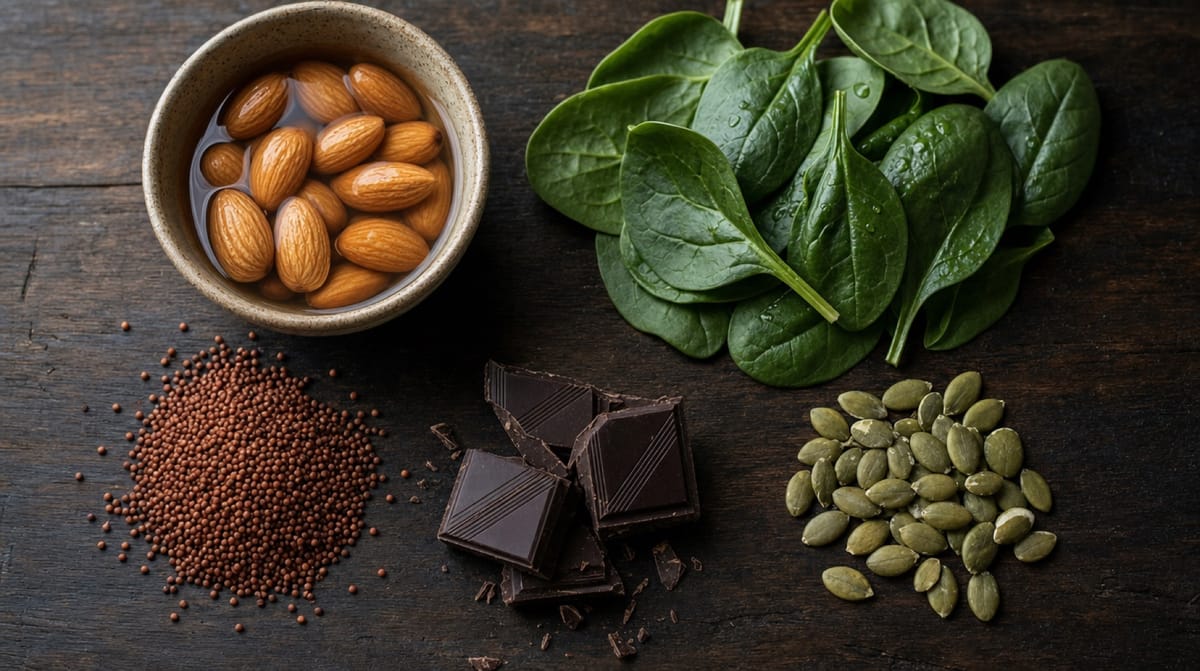
| Pumpkin seeds, hulled kernels (pepitas/kaddu ke beej kernels) | ~550mg | Hulled kernels only; whole seeds with shell are ~185mg/100g. One small handful (~28g) covers ~140mg |
| Cashews | ~292mg | Easy daily snack; moderate portion needed |
| Almonds | ~270mg | ~23 almonds (28g) provides ~75mg |
| Chia seeds | ~335mg | Works in dal or curd; soak before eating |
| Dark chocolate (70%+) | ~228mg | Small quantities meaningful |
| Moringa leaves (drumstick leaves/sahjan) | ~147mg | Widely available in South India; underused in North |
| Rajma (kidney beans) | ~138mg | Standard Indian dal; soak and cook from dried for higher nutrients |
| Ragi (finger millet) | ~137mg | Superior to white rice and maida for magnesium |
| Bajra (pearl millet) | ~137mg | Widely available; bhakri, bajra roti are practical formats |
| Jowar (sorghum) | ~165mg | Used in bhakri across Maharashtra, Karnataka, Rajasthan |
| Chickpeas (chana) | ~115mg | Chana dal or chole; preparation method matters |
| Spinach (palak) | ~79mg | Volume needed for significant contribution; pair with vitamin D |
| Banana | ~27mg | Modest contribution; often cited but not a high-magnesium food |
| Brown rice | ~44mg | Significantly more than white rice (~35mg); practical substitute |
An adult Indian man aiming for 440mg/day can reach this through: 30g pumpkin seeds (~165mg), one katori rajma or chana (~55mg), one ragi or bajra roti (~55mg), a serving of palak sabzi (~40mg), and 30g almonds or cashews (~80mg), which sums to approximately 395mg. Adding a small portion of dark chocolate or chia seeds closes the gap. This is achievable within a standard Indian meal pattern without supplementation, provided the foods are actually present in the diet.
How to Maximise Absorption From Food
Getting magnesium into the diet is not the only challenge. The proportion absorbed from food matters equally.
Soaking rajma, chana, and other legumes for 8 to 12 hours before cooking, and discarding the soaking water, reduces phytate content significantly and improves mineral absorption. Sprouting (allowing soaked legumes to germinate for 24 to 48 hours) further reduces phytates through phytase enzyme activation. These are traditional practices in Indian food preparation that are being lost in urban cooking, where pressure cookers and quick-cook legumes are the norm.
Avoiding high-calcium supplementation alongside magnesium-rich meals helps because calcium and magnesium share absorption transporters in the gut and compete at high concentrations. This does not mean avoiding dairy, which provides calcium at levels well within the normal dietary range. It means avoiding high-dose calcium supplements taken with magnesium-rich meals.
Vitamin D is required for optimal magnesium absorption, and given India's widespread Vitamin D deficiency, optimising Vitamin D status is indirectly relevant to magnesium status. See our guide on Vitamin D deficiency in India for context. Gut health generally affects mineral absorption. Conditions including inflammatory bowel disease, celiac disease, and chronic diarrhoea reduce magnesium absorption from food and significantly elevate deficiency risk.
When to Consider Magnesium Supplements
For most Indians eating a reasonably varied whole-food diet, dietary correction is the appropriate first step before supplementation. Supplements become appropriate when dietary adequacy cannot be maintained, specific clinical indicators are present, or a doctor has recommended them based on test results.
Several forms of magnesium supplements are available in India, and they differ in bioavailability and side effects. Magnesium oxide (the most common and cheapest form) has poor bioavailability, with published studies reporting estimates ranging from 4% to 31% depending on dose and study conditions. This is consistently the lowest of the common forms. Magnesium citrate has better absorption but can cause loose stools at higher doses. Magnesium glycinate (magnesium bisglycinate) has the highest bioavailability among commonly available forms, causes minimal gastrointestinal side effects, and is the most appropriate form for people with sensitive digestion. Magnesium chloride (topical or oral) and magnesium malate are also well-absorbed forms.
The US Institute of Medicine sets a tolerable upper intake level of 350mg per day for supplemental magnesium in adults. ICMR-NIN 2020 has not established a specific upper limit for magnesium supplements, so the IoM figure is the relevant practical ceiling for supplement dosing guidance. Higher doses from supplements (not from food) can cause diarrhoea, nausea, and in people with impaired kidney function, serious toxicity. Supplements should be avoided or used only under medical supervision in people with significant kidney disease. For people on cardiac medications, diuretics, or antibiotics (magnesium can interfere with tetracycline absorption), a doctor or pharmacist should be consulted before starting supplementation.
Check the label of any magnesium supplement for FSSAI licence number and, ideally, evidence of NABL-accredited third-party testing. The FSSAI licence is mandatory for legally sold supplements in India, and its absence is a red flag. For guidance on reading supplement and food labels, see our guide to label literacy in India.
The Bottom Line
Magnesium deficiency in India is real, structurally driven, and clinically documented across multiple vulnerable populations. Elderly patients, people with Type 2 diabetes, and critically ill adults have all been shown in India-specific peer-reviewed studies to have significantly elevated hypomagnesemia rates. The dietary gap reflects a double bind: India's traditional whole-grain and legume-based diet contained adequate magnesium, but the urban dietary transition toward refined grains is reducing it, and the phytate content of the legumes that remain in the diet partially limits what is absorbed.
The practical response does not begin with a supplement. It begins with returning magnesium-dense whole foods to the Indian plate: ragi and bajra over white rice and maida, soaked and sprouted legumes, a small daily portion of nuts and seeds, and leafy greens in adequate quantity. For those who cannot meet requirements through diet, or who fall into high-risk groups, a well-absorbed magnesium form such as magnesium glycinate at a dose guided by a healthcare provider is appropriate. And for anyone experiencing persistent muscle cramps, poor sleep, fatigue, or high blood pressure alongside elevated stress, a conversation with a doctor about magnesium status is a reasonable starting point.
Action This Week
Pick one. Swap white rice or maida roti for ragi or bajra at one meal a day. Add a small handful (~30g) of pumpkin seeds or almonds to your morning routine. If you experience persistent muscle cramps, poor sleep, or migraines alongside any of the risk factors above (diabetes, PPI or diuretic use, high stress), book a consultation with your doctor and ask specifically about magnesium status.
Stay informed on nutrition and preventive health in India
SwasthiQ covers India-specific evidence on nutritional deficiencies, food safety, and preventive care. Subscribe to our monthly newsletter for plain-language coverage: evidence-based, no supplement industry hype.
Think Care · Think SwasthiQ
Related reading: Vitamin D deficiency in India: why sunlight is not enough | How to read food labels in India: FSSAI decoded | Important annual medical tests every adult in India should know