Heartburn or Something More Serious? What Your Gut Is Trying to Tell You
Indian studies put GERD prevalence between 7.6% and 22%, rising with obesity and urbanisation. Most Indians treat heartburn with home remedies or over-the-counter antacids and miss the alarm symptoms that should trigger urgent investigation. Clinical definitions, India-specific risk factors, and whe
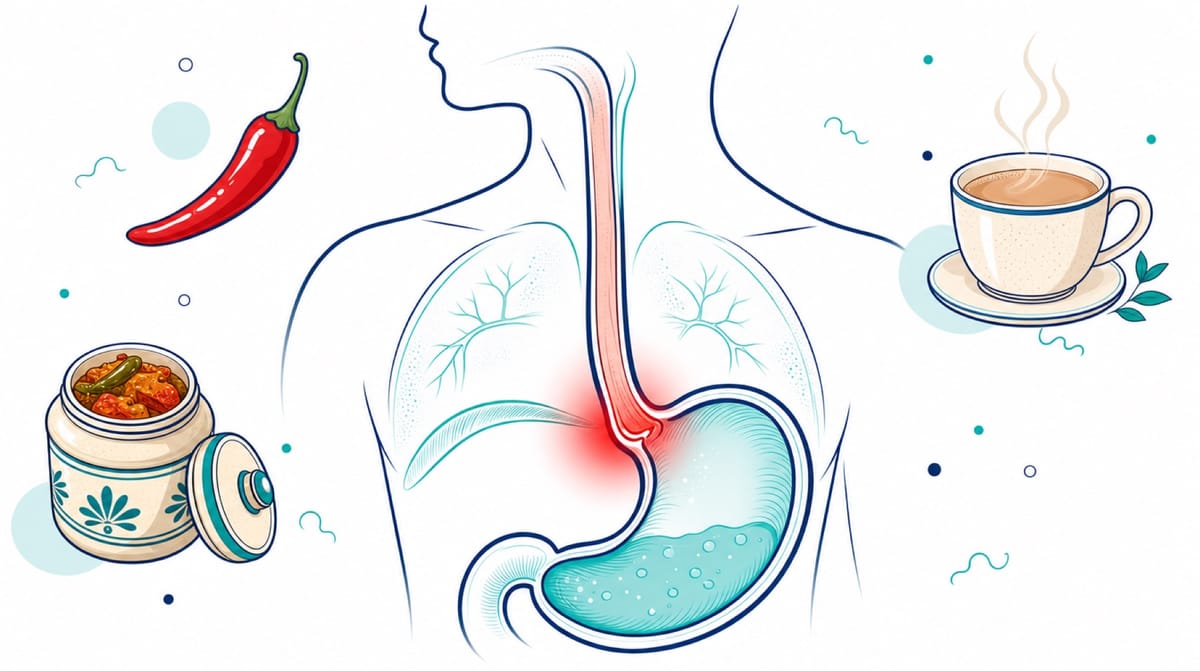
Important: This article is for informational purposes only and does not constitute medical advice. If you are experiencing chest pain, difficulty swallowing, blood in stool, vomiting blood, or unexplained weight loss alongside digestive symptoms, seek medical attention promptly. Chest pain should always be evaluated by a doctor to exclude a cardiac cause before attributing it to heartburn.
Most Indians who experience heartburn do not see a gastroenterologist. They take an antacid, perhaps mix jeera water or drink cold milk, and carry on. When symptoms persist, they might graduate to a proton pump inhibitor bought over the counter at a chemist and continue for months or years without ever establishing a diagnosis. This pattern is understandable. Heartburn is common, is culturally associated with "acidity," and its connection to more serious conditions is poorly communicated in India's primary care and general public awareness frameworks.
But the pattern has consequences. A survey of Indian patients with GERD found that 34.3% were using daily medications for symptom relief without a formal diagnosis or monitored treatment plan. And a subset of people who attribute their symptoms to simple "acidity" are living with Barrett's oesophagus, a precancerous condition that develops from unmanaged chronic gastroesophageal reflux and that is detectable and manageable if found in time.
GERD affects between 7 and 22% of Indian adults depending on the population studied, is rising with India's obesity and urbanisation trends, and is frequently mismanaged while the alarm symptoms that signal serious complications are not being recognised as requiring urgent medical evaluation. This guide covers what heartburn, acid reflux, and GERD actually are, what the India-specific epidemiology shows, which symptoms require prompt attention, and what does and does not have evidence behind it as a treatment.
SwasthiQ is building Healthcare Rails for India, the connected ecosystem that links GI symptom history, PPI prescription patterns, H. pylori testing, and endoscopy findings so an Indian adult who has been self-medicating for years has a clinical record that catches Barrett's before it becomes adenocarcinoma.
Official sources: Bhatia et al., ISG Task Force, Indian J Gastroenterology | BMC Gastroenterology 2016, PMC4791779 | PMID 30790137, Vellore Tamil Nadu study | NIDDK, US National Institute of Digestive Diseases | NHS UK, Heartburn and Acid Reflux
Heartburn, Acid Reflux, and GERD: The Clinical Definitions
These three terms are frequently used interchangeably in India but describe distinct and hierarchical clinical concepts.
Heartburn is a symptom, a burning discomfort or pain behind the breastbone (sternum) that typically occurs after eating and often worsens when bending over or lying down. The name is misleading. The heart has nothing to do with it. Heartburn occurs in the oesophagus when stomach acid flows back (refluxes) up from the stomach and contacts the comparatively delicate lining of the oesophagus, which lacks the protective mucous layer that the stomach has to handle its own acid. Occasional heartburn (after a very spicy meal, after lying down after eating, or during pregnancy) is normal and does not indicate disease.
Acid reflux (also called gastro-oesophageal reflux, GER) describes the physiological event of stomach contents flowing backward into the oesophagus. The lower oesophageal sphincter (LES), a circular muscle at the junction of the oesophagus and stomach, is the valve that normally prevents this retrograde flow. When the LES is weak, relaxes inappropriately, or is overcome by pressure (from obesity, pregnancy, or hiatal hernia), acid reflux occurs. The acidity causes heartburn, and sometimes regurgitation of sour or bitter liquid into the mouth or throat.
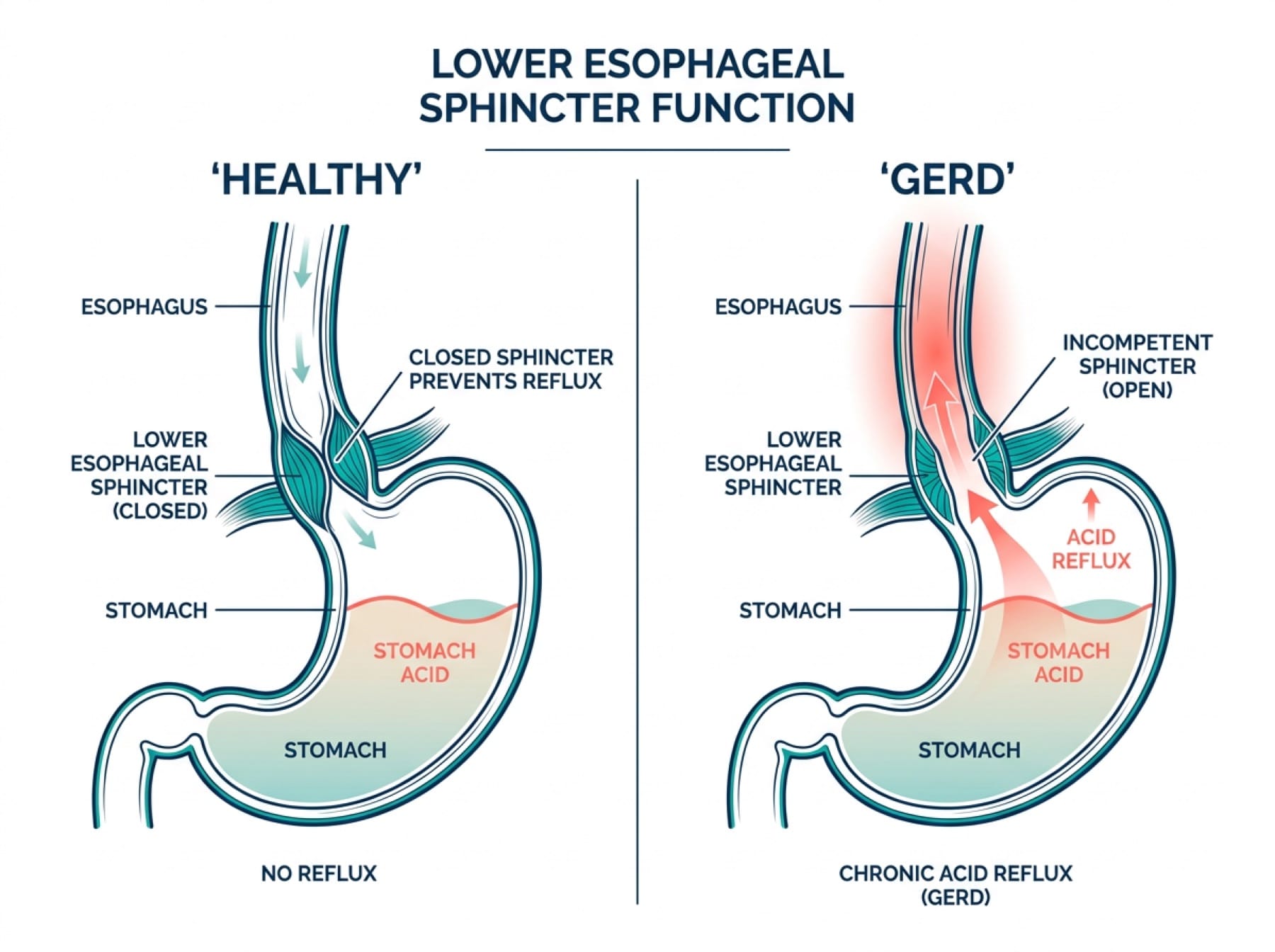
Side by side diagram of a healthy closed lower oesophageal sphincter versus a weakened one allowing acid reflux upward
GERD (gastro-oesophageal reflux disease) is the chronic form of acid reflux. The internationally accepted Montreal Definition (Vakil et al., American Journal of Gastroenterology, 2006) classifies GERD as reflux that causes troublesome symptoms or complications, with heartburn or regurgitation occurring at least twice per week being the commonly applied frequency threshold. GERD is a disease, not a symptom, and it carries a clinical consequence. Chronic acid exposure to the oesophageal lining causes inflammation (oesophagitis), and over years can cause structural changes that carry cancer risk.
Acid Reflux in India: What Our Own Data Shows
GERD has historically been considered a Western disease, with epidemiological studies in the 1990s suggesting that prevalence in South Asia was substantially lower than in Europe and North America. The growing body of Indian epidemiological data tells a more complex story.
The Indian Society of Gastroenterology (ISG) formed a task force to specifically study GERD in India. The resulting multi-centre prospective study by Bhatia et al. (covering 3,224 urban and rural patients across 12 centres) found a weekly GERD prevalence of 7.6% in the Indian population. A community-based study conducted in southern India and published in BMC Gastroenterology in 2016 (PMC4791779), using a validated GERD questionnaire with 1,072 participants across multiple sampling sites, found GERD prevalence of 22.2%. A larger community study in Vellore, Tamil Nadu (PMID 30790137), covering 6,174 participants, found GERD in 8.2%, with urban prevalence (11.1%) more than double rural prevalence (5.1%). A rural India-specific study (PMID 33443640) found GERD in 10.7% of participants. The Indian Journal of Gastroenterology's editorial synthesis of these studies estimates India's GERD prevalence at 8% to 19% across populations.
The variation in these figures reflects methodological differences (different diagnostic thresholds, different populations, different survey instruments), but the convergence is clear. India's GERD burden is substantial, rising, and significantly higher than historical assumptions suggested.
The same community studies identify India-specific risk factors. Obesity and overweight carry dose-dependent risk: the BMC Gastroenterology study found overweight individuals had 1.4 times the GERD risk of normal-weight individuals, and obese individuals had 2.3 times the risk. Urban residence approximately doubles GERD risk compared to rural settings, consistent with urbanisation-associated lifestyle changes including higher-fat diets, late-night eating, and increased alcohol and carbonated beverage consumption. Pan masala and tobacco chewing are associated with GERD in multiple Indian studies. Age above 30 and female gender are also independent risk factors in some studies.
Why India Is at Particular Risk
India's GERD burden is shaped by several converging factors specific to its dietary, metabolic, and lifestyle context.
India's obesity and metabolic disease prevalence has risen substantially. ICMR-NIN data, summarised in the Dietary Guidelines for Indians (ICMR-NIN 2024 revision), documents the proportion of overweight and obese Indians has risen from 25% in 2013 to nearly 40% in 2023 using Asian BMI thresholds. Obesity increases GERD risk through increased abdominal pressure on the LES and promotion of transient LES relaxations. As India's obesity burden grows, its GERD burden grows proportionally.
The typical patterns of Indian eating (large, late-evening meals with significant spice and fat content eaten close to bedtime, and the cultural practice of lying down after a heavy meal) are mechanically unfavourable for LES function. Fatty meals delay gastric emptying (meaning food stays in the stomach longer, increasing the period of reflux risk). Eating within two to three hours of lying down is one of the most consistently documented GERD risk factors across the literature.
H. pylori, the bacterium responsible for most peptic ulcers and a significant proportion of chronic gastritis, has an estimated prevalence of approximately 70% in India per a 2024 Indian Journal of Gastroenterology meta-analysis by Singh et al. (PMC11217093, pooled across 51 Indian community studies), one of the highest rates in the world. The relationship between H. pylori and GERD is complex and bidirectional in ways not fully resolved in the literature. What is clinically important is that H. pylori infection can produce GERD-like symptoms (upper abdominal discomfort, nausea, regurgitation) that may be misattributed to GERD and treated with PPIs when H. pylori testing and eradication therapy would be more appropriate. For patients whose GERD symptoms do not respond adequately to lifestyle changes and PPIs, H. pylori testing with a breath test, stool antigen test, or endoscopic biopsy is clinically warranted.
The Alarm Symptoms That Require Prompt Medical Attention
For most people, uncomplicated heartburn that responds to antacids or lifestyle changes does not require urgent evaluation. The following symptoms do.
Dysphagia (difficulty swallowing) is the sensation that food is sticking in the throat or chest. It is a red flag in the context of GERD because it may indicate oesophageal stricture (narrowing of the oesophagus from chronic acid scarring) or, more seriously, oesophageal cancer. Any new difficulty swallowing requires gastroenterological evaluation and upper GI endoscopy.
Odynophagia (painful swallowing) is pain on swallowing rather than just difficulty. It similarly requires investigation, as it may indicate oesophageal ulceration or infection.
Unexplained or unintentional weight loss alongside GI symptoms always requires investigation. Weight loss in the context of difficulty eating or dysphagia raises the clinical concern for oesophageal or gastric malignancy.
Blood in stool (melaena, meaning black tarry stools, or frank blood) or vomiting blood (haematemesis) are gastrointestinal bleeding signs that are medical emergencies. They can arise from oesophageal ulceration, a Mallory-Weiss tear from repeated vomiting, or peptic ulcer disease. These require emergency medical care.
Unexplained anaemia (iron deficiency anaemia without an obvious source of blood loss) can result from chronic GI bleeding that is not visible to the naked eye (occult blood). In someone with chronic GERD symptoms, this combination warrants endoscopic investigation.
Heartburn symptoms that have persisted for more than five to ten years without investigation, particularly in adults over 50, are an indication for a one-time upper GI endoscopy to screen for Barrett's oesophagus, even if symptoms are controlled. This is not universal screening. It is targeted risk assessment for a high-risk group.
Heartburn vs Heart Attack: The Critical Distinction
This deserves its own clear section because the consequence of getting it wrong is potentially fatal.
Both heartburn and a heart attack can cause chest pain or discomfort, particularly in the region behind the breastbone. The features that more commonly suggest heartburn rather than cardiac pain include: a burning quality that worsens with bending or lying down, onset after eating, relief with antacids, and absence of exertion as a trigger.
Features that more commonly suggest a cardiac cause include: pressure, squeezing, or tightening quality (rather than burning), pain that radiates to the jaw, neck, left arm, or shoulder, onset with exertion or at rest without relation to eating, associated sweating, shortness of breath, or nausea, and absence of improvement with antacids.
However, these distinctions are not absolute. Women, people with diabetes, and older adults frequently experience atypical cardiac symptoms including fatigue, nausea, or mild chest discomfort without the classic "squeezing" quality. Any chest pain that is new, severe, or accompanied by breathlessness, sweating, or radiation to the arm or jaw should be treated as a potential cardiac event and assessed at an emergency facility immediately. Call 112. Do not take an antacid and wait for improvement. Cardiac symptoms that are dismissed as heartburn carry a mortality cost.
Barrett's Oesophagus: The Complication Most Indians Have Not Heard Of
Barrett's oesophagus is a condition in which the normal squamous epithelial lining of the lower oesophagus is replaced by columnar epithelium resembling intestinal lining (a process called intestinal metaplasia) as a response to repeated acid injury. Barrett's oesophagus is clinically important because it is a precancerous condition. Individuals with Barrett's oesophagus have a substantially elevated risk of developing oesophageal adenocarcinoma compared to the general population.
The risk of developing Barrett's oesophagus rises with the duration and severity of GERD. It is most commonly found in adults over 50 with long-standing GERD, though it can occur in younger adults. A paradox of Barrett's oesophagus is that the metaplastic tissue is less sensitive to acid than normal oesophageal tissue, meaning that some people with Barrett's actually experience fewer heartburn symptoms (not more) as the condition develops. The absence of heartburn does not mean the absence of Barrett's.
Barrett's oesophagus is diagnosed by upper GI endoscopy with biopsy. Management depends on the degree of dysplasia (abnormal cell change) found on biopsy and ranges from surveillance endoscopy at intervals to endoscopic treatment. The key point for Indian patients is that long-standing unmanaged GERD is the strongest risk factor, and the opportunity to detect Barrett's before it progresses to cancer exists if the condition is recognised.
What Works and What Doesn't: Heartburn Remedies and Treatments
India has an extensive repertoire of home remedies for heartburn, most of which have at best mild symptomatic effects and at worst may delay appropriate treatment. This is not a dismissal of traditional practices. It is an evidence-calibrated assessment.
What has strong evidence. Lifestyle modifications are the most evidence-based first-line interventions for mild-to-moderate GERD. Losing weight if overweight or obese (even modest weight loss reduces GERD frequency), avoiding meals within two to three hours of bedtime, elevating the head of the bed by 15 to 20 centimetres (using a wedge rather than extra pillows, which can worsen symptoms), avoiding trigger foods (spicy, fatty, and acidic foods; caffeine; alcohol; carbonated beverages; chocolate; and onions for most people), eating smaller meals, and stopping smoking all have documented evidence for reducing GERD symptoms. These modifications address the physiological mechanism, not just the symptoms.
Proton pump inhibitors (PPIs), where omeprazole, pantoprazole, and rabeprazole are the most commonly used in India, are the most effective pharmacological treatment for GERD and oesophagitis, and have a strong and consistent evidence base across multiple clinical trials. They reduce acid secretion by blocking the proton pump in gastric parietal cells and are appropriate for GERD when lifestyle modifications alone are insufficient. PPIs should be used at the minimum effective dose for the minimum necessary duration, and should not be continued indefinitely without periodic reassessment by a doctor.
H2 receptor blockers (famotidine is the currently available option in India, as ranitidine was withdrawn globally in 2020 due to NDMA contamination) reduce acid secretion less potently than PPIs and are appropriate for mild, infrequent symptoms. Antacids provide rapid but short-lived symptomatic relief and are appropriate for occasional use but not as ongoing treatment for GERD.
What has limited or no peer-reviewed evidence. Cold milk provides temporary symptom relief for some people by transiently alkalinising the stomach, but the calcium in milk subsequently stimulates more acid secretion ("acid rebound"), making it an unreliable management strategy. Jeera (cumin) water, ajwain (carom seed) water, and similar home preparations: traditional use is well-documented in Indian practice but peer-reviewed clinical trial evidence for GERD-specific benefit is absent or minimal. Aloe vera juice: some small pilot studies show possible benefit for GERD symptoms, but evidence is insufficient for a clinical recommendation. These remedies are not harmful for most people and may provide comfort, but substituting them for effective therapy when GERD is causing significant symptoms or complications risks missing the window for appropriate treatment.
PPI overuse: an India-specific concern. Proton pump inhibitors are appropriate when clinically indicated but are widely overused in India. They are prescribed for undiagnosed upper GI symptoms, for functional dyspepsia that does not involve acid, and continued without regular reassessment. Long-term PPI use is associated with magnesium depletion, vitamin B12 malabsorption, increased risk of C. difficile infection, and potentially increased fracture risk. PPIs dispensed over the counter without a diagnosis and continued indefinitely are a pattern that India's primary care and pharmacy systems need to address. If you have been taking a PPI daily for more than four weeks, your prescribing doctor should be involved in determining whether continued use is indicated and for how long.
When to See a Doctor
Occasional heartburn does not require a medical consultation. The following circumstances do.
Heartburn or regurgitation occurring two or more times per week for more than four weeks warrants a doctor's assessment, as this meets the frequency threshold for possible GERD and may require investigation and structured treatment.
Any of the alarm symptoms described earlier (difficulty swallowing, painful swallowing, unexplained weight loss, blood in stool or vomit, or unexplained anaemia) require prompt medical evaluation regardless of heartburn frequency.
Heartburn symptoms in someone over 50 who has had them for more than five years without endoscopic investigation warrant discussion with a gastroenterologist about one-time Barrett's oesophagus screening.
Heartburn that does not respond adequately to a trial of PPIs, or that recurs immediately when PPIs are stopped, warrants referral to a gastroenterologist for investigation, as poorly responsive GERD may indicate H. pylori co-infection, non-acid reflux, or another upper GI pathology.
For more on what annual tests Indian adults should include in their preventive health evaluation, see our age-group guide to annual health tests.
The Bottom Line
Heartburn is India's gut signalling something real, and most of the time, what it is signalling is manageable with lifestyle changes and appropriate short-term medication. The problem is not that heartburn is incurable. The problem is that a condition affecting 7 to 22% of Indian adults is being managed at the kitchen shelf while the alarm symptoms that require an endoscope and a gastroenterologist are being attributed to "gas" or "acidity" until the damage is done. Barrett's oesophagus does not develop overnight. Neither does oesophageal adenocarcinoma. The window for detection and intervention exists, but only if the symptoms that should trigger evaluation are recognised for what they are.
Action This Week
Pick one. If you have been taking a PPI (omeprazole, pantoprazole, rabeprazole) daily for more than four weeks without a doctor's review, book a gastroenterology consultation to reassess whether ongoing use is appropriate and consider H. pylori testing. If you are over 50 and have had heartburn symptoms for five years or more without ever having had an upper GI endoscopy, ask your doctor about a one-time Barrett's screening endoscopy. If you experience chest pain that is new, severe, or accompanied by breathlessness, sweating, or radiation to the arm or jaw, call 112 immediately. Do not assume it is heartburn.
Stay informed on digestive health and preventive care in India
SwasthiQ covers India-specific gastroenterological and preventive health evidence for patients and clinic owners. Subscribe to our monthly newsletter: evidence-based, no wellness-industry hype.
Think Care · Think SwasthiQ
Related reading: The annual health tests every Indian adult should get, by age group | Magnesium deficiency: the silent nutritional gap in Indian diets | Why Indian women are having heart attacks younger than ever