What is ABDM and ABHA? India's Digital Health Mission Explained
Over 88 crore Indians have an ABHA ID. What ABDM and ABHA are in plain English, and why 5 minutes today compounds into years of saved paperwork.
You walk into your doctor's clinic. The front desk flips through a paper register to find your visit from six months ago. If your test reports are at home, you go back without them. Referrals come on a paper slip the next specialist may or may not be able to read.
This is the daily reality at most Indian clinics. The doctor is there. The tests are available. The technology exists. What is missing is a system that connects all of it.
So what is ABDM? It is the government's answer to that gap. Over 88 crore Indians already have an ABHA ID (Ayushman Bharat Health Account) as of May 2026, per the official ABDM dashboard. India is adding roughly 60 lakh new ABHA IDs every month, based on the monthly delta visible on the same NHA dashboard between January and May 2026.
Here is the punchline of this article: creating an ABHA ID and choosing an ABDM-registered clinic is the single highest-leverage healthcare setup an Indian family can make in 2026. Every future government rollout (insurance integration, AI assistance, telemedicine, appointment booking) works automatically with what you set up today. The cost on your side is 5 minutes and zero rupees. The payoff compounds with every visit.
India is building a connected healthcare ecosystem on shared digital rails. ABDM is those rails. UPI is the analogy: every bank's payment system once stood alone, then UPI plugged them together and the entire payment experience changed for ordinary Indians overnight. Health is doing the same thing now, slower, with bigger stakes. SwasthiQ exists to cover what the rails are, how they work for an ordinary patient and an ordinary clinic, and what changes when you are on them versus off them. The five minutes is how you get on. The compounding starts the moment you do.
Here is what ABDM and ABHA are, how they work, what they change at your doctor's clinic, and what you can do this week to set yourself up.
What is the Ayushman Bharat Digital Mission (ABDM)?
ABDM is India's national digital health system. The clearest way to think about it: ABDM is the UPI of healthcare, the digital rails the country has been missing for two decades. Just as UPI connected every bank's payment system, ABDM connects every clinic, hospital, lab, and pharmacy's record system. Your medical history follows you, securely and with your permission, wherever you go for care in India.
It is run by the National Health Authority (NHA, the government body that also manages India's free insurance scheme for poor families, Ayushman Bharat Pradhan Mantri Jan Arogya Yojana or PMJAY).
Three things to know up front:
- ABDM is voluntary for you as a patient. You choose if you want to participate.
- It is paperless when you use it. Your records become digital.
- It is consent-based. No clinic can pull your records without your explicit permission.
What is an ABHA ID?
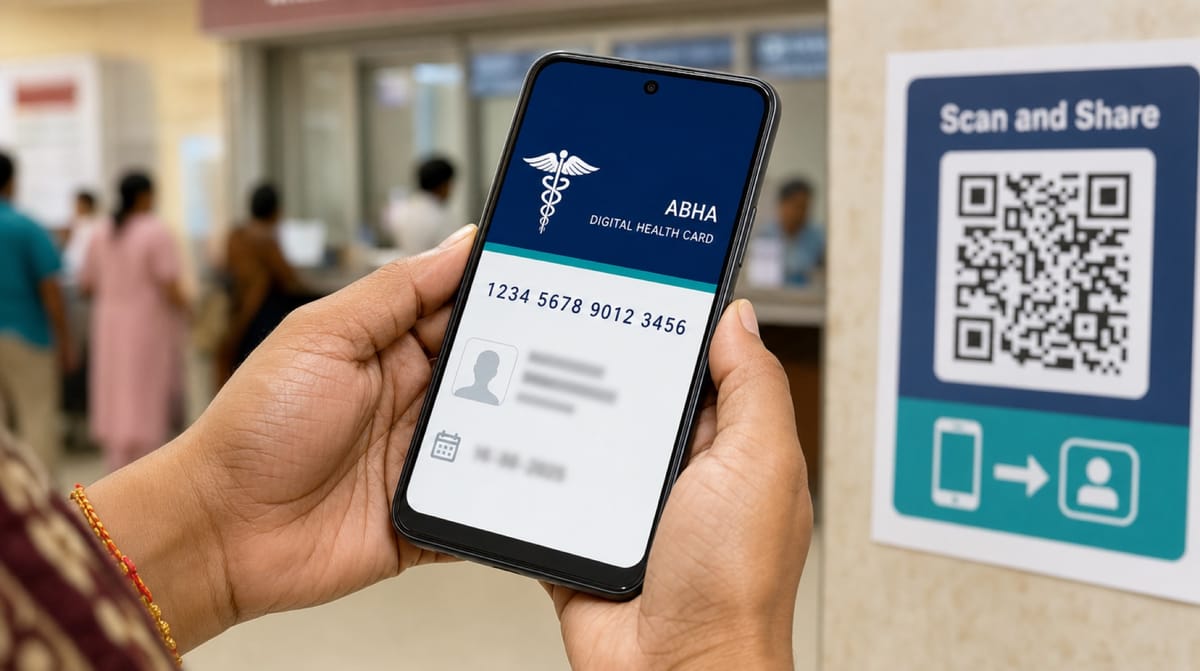
ABHA stands for Ayushman Bharat Health Account. Your ABHA ID is a 14-digit number that becomes your single digital identity for healthcare in India.
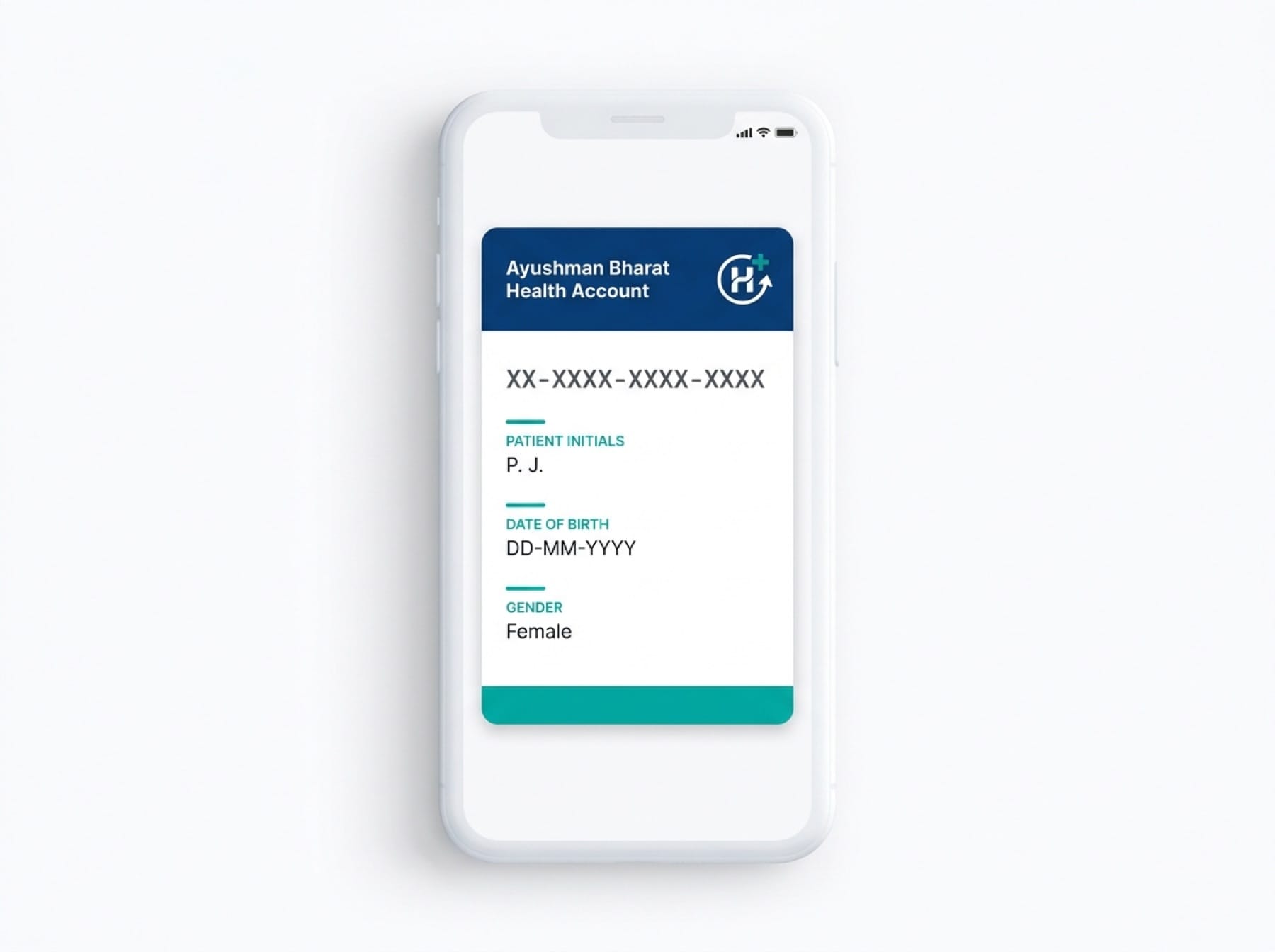
Mockup of a digital ABHA health card showing the masked 14-digit ID.
Unlike a hospital patient ID, which only works inside one hospital, ABHA is portable. The same number works at:
- A government primary health centre in rural Uttar Pradesh
- A private specialist clinic in Chennai
- A diagnostic lab in Pune
- A pharmacy anywhere in the country
Creating an ABHA ID is free and takes under 5 minutes. You can do it at abha.abdm.gov.in or by downloading the ABHA app. You need either your Aadhaar number or just your mobile phone.
Once you have an ABHA ID, every new medical record at an ABDM-registered clinic links to it. You decide who sees those records and for how long. Think of the ABHA ID as a personal health locker. Accessible anywhere in India, opened only when you give the key.
This is the half of the setup you can do this week, on your own, in 5 minutes.
How ABDM Records Actually Work (Without the Jargon)
The most common concern about a national digital health system: where is my data stored? Is there a single government database that could be hacked?
The answer is reassuring. ABDM does not put your records in one central place. It works as a federated system. Each clinic, hospital, or lab keeps the records they created. When you want to share with another doctor, ABDM acts as a bridge between them.
Here is how it works in four steps:
- You visit a clinic
- The clinic makes a digital record of your visit
- That record gets linked to your ABHA ID
- When you want another doctor to see it, ABDM asks for your permission, then makes the record visible to that doctor
There is no single hacking target. Every transfer needs your active permission. Records are encrypted both in transit and at rest, in line with NHA standards published at abdm.gov.in.
This consent step is handled by the HIE-CM (Health Information Exchange Consent Manager, the permission system inside ABDM that brokers every record share). This same federated, consent-controlled design is what makes the next ABDM rollouts (insurance, AI, telemedicine) plug in automatically. The infrastructure you connect to today is the same infrastructure every future capability runs on.
What ABDM Changes at Your Doctor's Clinic
Right now, a typical Indian clinic on paper spends roughly 30 to 45 minutes at the end of each day on register reconciliation, chasing missing lab slips, and re-filing physical records (SwasthiQ internal workflow estimate from clinics actively running paper-based OPDs; an India-specific time-and-motion study would strengthen this number further). With ABDM, that overhead largely disappears. Records are created digitally from the moment you check in. A small setup change at the clinic side compounds into hours of recovered time per week, plus a structured digital trail for every future capability.
Here is what changes from your side as a patient:
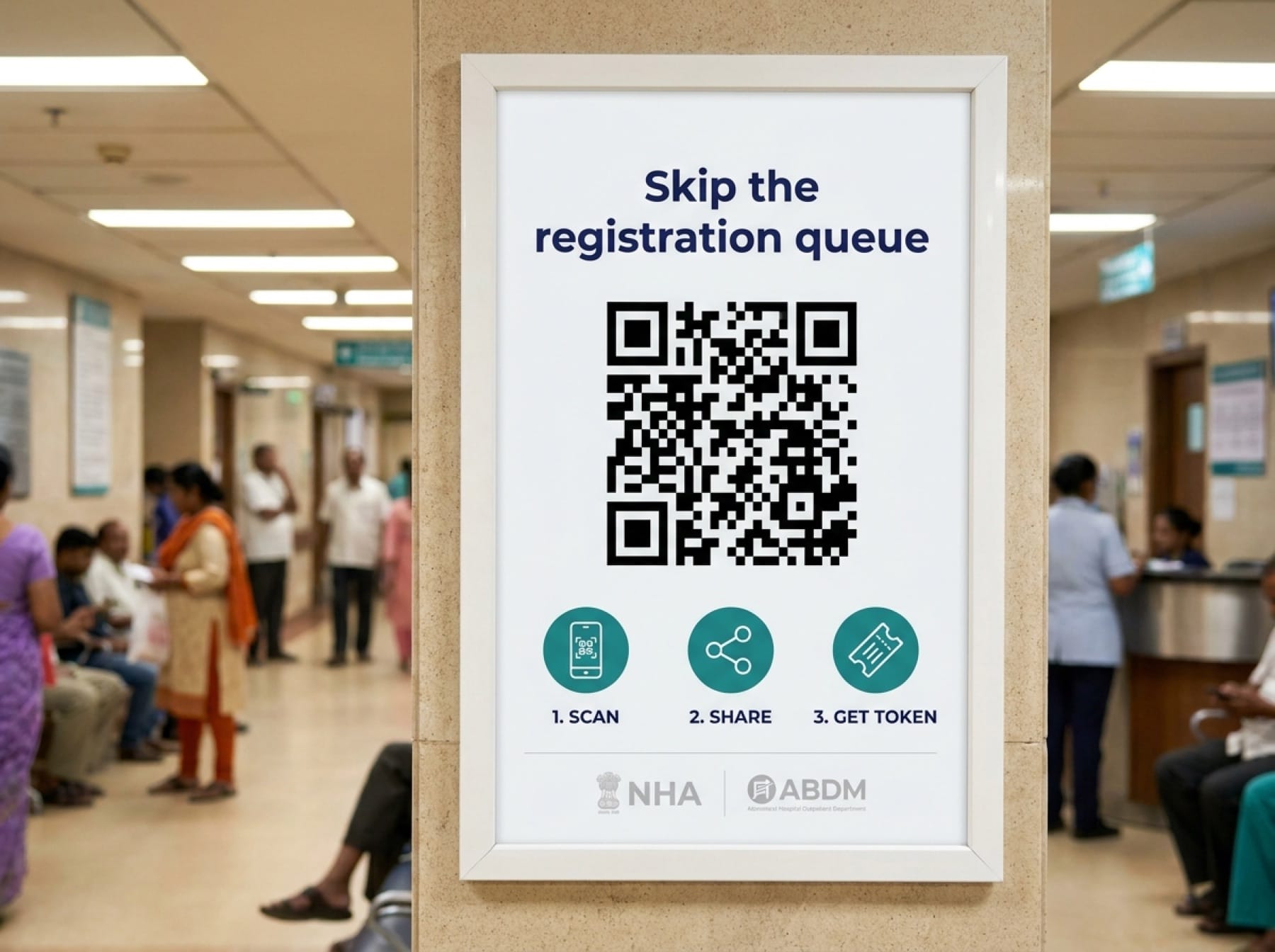
Clinic reception poster with a scan and share QR code to skip queues.
| At a paper clinic | At an ABDM-registered clinic |
|---|---|
| Fill a fresh patient form every visit | Show your mobile or ABHA ID; checked in under a minute |
| Carry physical reports or remember details | The doctor sees your full history with your consent |
| Handwritten prescription on a slip | Digital prescription stored permanently against your ABHA ID |
| Carry a paper letter for a referral | Records shared digitally with the next doctor |
| Lab reports arrive on paper | Lab results link straight to your ABHA-linked record |
For you, this means less paperwork, fewer duplicate tests because earlier results are already available, and faster diagnosis when speed matters.
The Privacy Question: Who Sees Your Data?
Health data is sensitive. The ABDM consent framework is built around one rule: nobody sees your records without your active permission. The framework is documented publicly on abdm.gov.in, and the National Health Authority reviews it as the standard for every Health Information Provider in the network. Every consent action you take is logged and visible to you on the ABHA app.
In practice:
- A doctor who wants your past records sends a consent request to your phone
- You approve it on the ABHA app or via OTP
- The doctor gets access for the time window you choose (a single visit, a week, a month)
- You can revoke access at any time from any device
- The data is encrypted both in transit and at rest
You are the gatekeeper. Always.
This is the same consent model that will govern every future ABDM layer: insurance pre-approvals through NHCX (the National Health Claims Exchange, the upcoming layer that connects clinics directly to insurers), AI assistance at the doctor's desk, telemedicine. The permission flow you learn once on the ABHA app is the permission flow you use everywhere later.
The Six Building Blocks of ABDM
These six pieces work together to make ABDM run. Each one is a small infrastructure block. Together they form the rails the entire mission rides on. Future capabilities (NHCX insurance, AI assistance, UHI appointments) plug into the same six blocks. The blocks themselves do not change; only what runs on top of them does. That is why setting up your ABHA ID today is leverage: every new layer the government adds works automatically with what you already have.
You will see these names if you read about ABDM elsewhere, so here they are in plain language:
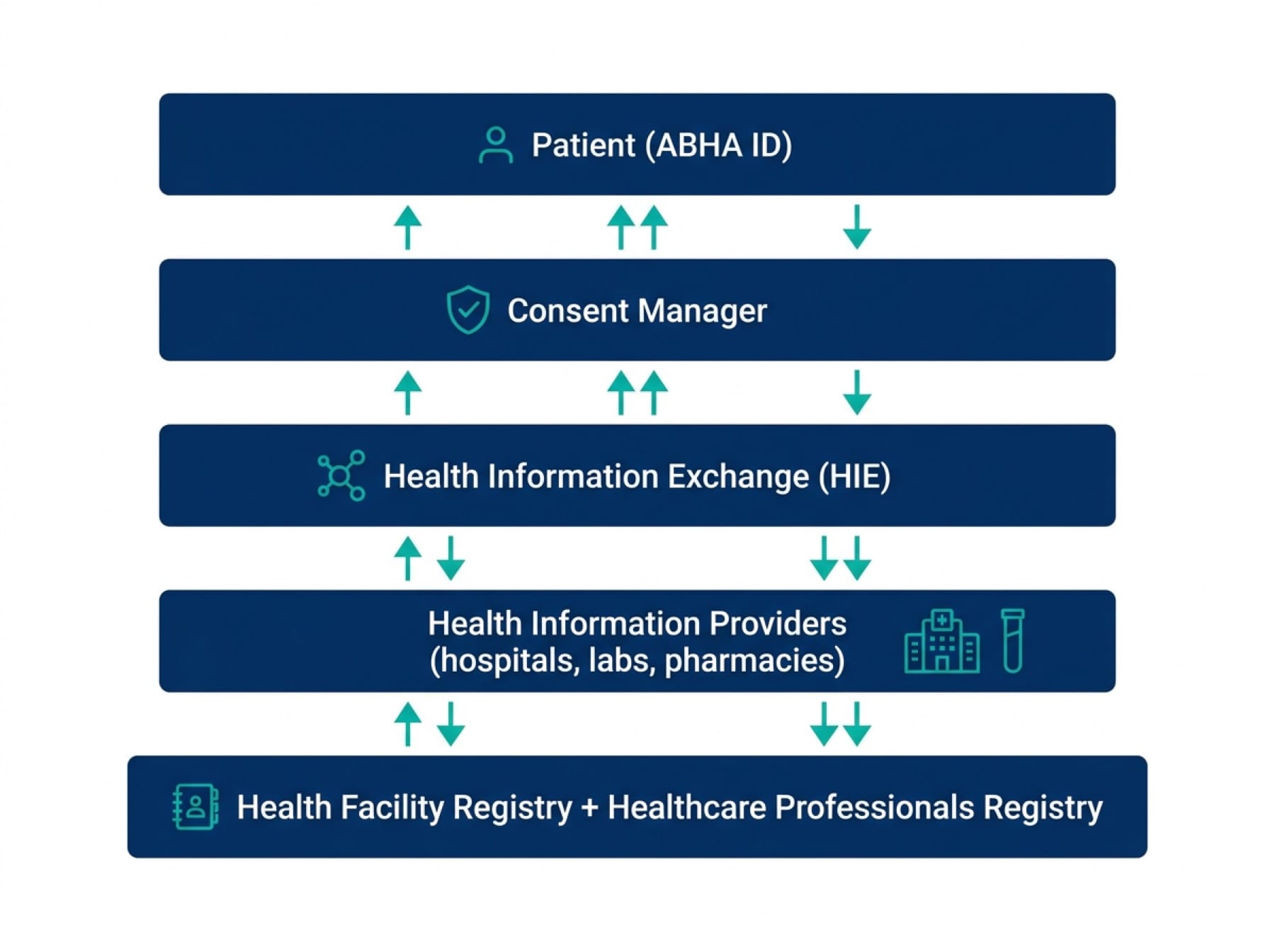
Diagram of ABDM's five-layer architecture from ABHA ID to health registries.
| Component | What it is | What it does for you |
|---|---|---|
| ABHA ID | Your 14-digit national health identity | Carries your records across every ABDM-registered clinic in India |
| HPR (Healthcare Professionals Registry) | National database of registered doctors and nurses | Lets you verify the doctor you are seeing is actually registered |
| HFR (Health Facility Registry) | National directory of clinics, hospitals, and labs | Confirms a facility is officially listed |
| HIE-CM (Health Information Exchange Consent Manager) | The permission system | Asks you before any data moves between providers |
| PHR apps (Personal Health Records apps) | The ABHA app and other government-approved PHR apps | Where you actually view your linked records on your phone |
| UHI (Unified Health Interface) | The upcoming network for booking healthcare digitally | Will let you discover and book appointments across providers |
You only need to interact with two of these directly: your ABHA ID and the PHR app on your phone. The rest run in the background.
All six layers are already operational. That matters more than it sounds. Every new ABDM capability the government rolls out (NHCX for insurance, UHI v2 for appointments, AI clinical decision support) is being built on top of these same six layers. Setting up your ABHA ID today is what lets you ride every new capability without any further action on your side.
What This Means for Your Doctor and Your Clinic
ABDM is not a free upgrade for clinics. It requires the clinic to use software that supports ABDM and produce records in a standard format called FHIR R4 (the international format that lets different medical software talk to each other; the India-specific profile lives at nrces.in/ndhm/fhir/r4). An ABDM-registered clinic is officially called a Health Information Provider (HIP, the formal label for any clinic in the network).
For you as a patient, the practical question is: is your regular clinic on ABDM? You can ask them. There is no extra government charge to them. The cost is the software they use. If you are a clinic owner reading this, our clinic management software in India guide covers what to verify before signing with a vendor, and our EMR vs paper documentation comparison walks through the operational reality of switching.
Why Timing Matters: The Next 18 Months
The leverage argument is not theoretical. The government has a known roadmap for the next 18 months, and the order matters.
The next three ABDM layers being rolled out (per the official roadmap at abdm.gov.in) are:
- NHCX (National Health Claims Exchange). A direct connection between clinics and health insurers, so claims and pre-approvals stop needing paperwork or fax machines. Patients with an ABHA ID linked to their existing insurance get one-tap pre-approval at the clinic counter.
- UHI v2 (Unified Health Interface, the appointment-booking layer). Discover and book appointments from one app, the way you book autos today.
- AI clinical assistance at the doctor's desk. Models that read your full ABHA-linked history, summarise the key points, and flag drug interactions or repeated tests. (For how India is already training doctors to use these tools, see our AI in medical education guide.)
Every one of these is built on the six layers already operational today. Clinics that register this quarter and families that create ABHA IDs this week both inherit these capabilities on launch day. A clinic that waits a year faces the same setup retroactively: software switch, HIP registration, FHIR R4 migration, and patient onboarding all at once. By then, the competitor down the road is a year into the data network.
That is why this article is mostly setup advice, not awareness content. The window where setup is easy and there is no migration cost is open right now.
The Hard Parts: What Still Needs Work
ABDM is ambitious. The mission has done the heavy lifting on the technology side and on the legal framework. Real friction remains in 2026. None of it reverses the leverage argument: it slows the rate at which your setup compounds. Four points where the compounding slows down:
- Your clinic does not know what ABDM does for you yet. Even with 88 crore-plus ABHA IDs in the system, awareness gaps in smaller cities and regional-language settings mean your front desk may not yet ask for your ABHA ID. Compounding starts the day they do.
- You find digital consent flows confusing. Older patients and rural users may need a family member to walk them through the ABHA app the first time. After the first time, every consent flow is the same shape, so the learning compounds.
- Your clinic's internet drops for hours. Connectivity issues in tier-2 and tier-3 cities are real. Good ABDM-compliant software syncs offline and catches up when connectivity returns, so your records still compound across visits.
- Your regular clinic is not on ABDM yet. Small primary care clinics may not have registered. Asking your doctor about their timeline puts compounding on the calendar, even if it does not start today.
If you have a long-term health condition, ask your doctor if they plan to register with ABDM. Find out what that would change for how you and they share information. Do not change any treatment plan based on this article alone. Always consult your doctor for medical decisions.
What You Can Do This Week
This is the action half of the article. The setup is what defends the thesis.
If you are a patient or a family member:
- Create your ABHA ID at abha.abdm.gov.in. Free, under 5 minutes.
- Ask your regular clinic whether they are ABDM-registered.
- Start linking your existing test reports and prescriptions to your ABHA account through the ABHA app.
- Get comfortable with the consent flow so the next time a doctor requests records you know what to expect.
If you run or work in a clinic (one line, our clinic software buyer's guide has the full version): move to ABDM-compliant clinic software with HIP onboarding included, and register the facility in the Health Facility Registry.
Five minutes today. Years of paperwork avoided. Every future capability the government adds works automatically with what you set up now.
The Bottom Line
An ABHA ID and an ABDM-registered clinic are the smallest setup with the biggest payoff in Indian healthcare right now. The reason is simple. Every future capability the government rolls out (NHCX insurance integration, AI assistance, telemedicine, UHI appointment discovery) works automatically with the ABHA ID and the ABDM network you set up today. No re-integration, no migration cost, no scramble later.
For you as a patient, you stop being the keeper of paper files. For your doctor, it means a fuller picture of your health every time you walk in. For Indian healthcare, it is the connected ecosystem and the digital rails this country has been missing for two decades.
The setup is free, takes 5 minutes, and the benefit compounds with every visit. The single best healthcare action an Indian family can take this week is also the easiest.
Create your ABHA ID this week at abha.abdm.gov.in. Then ask your regular clinic if they are ABDM-registered. Those two steps put you on the rails.
Think Care · Think SwasthiQ
Related reading: How to choose clinic management software in India