What Is an EMR in India? A Plain-Language Guide for Doctors and Clinic Owners
An EMR (electronic medical record) is the digital equivalent of the paper case file your clinic has always maintained, but searchable, shareable with consent, and ABDM-compliant. EMR vs EHR, what it contains, and what to evaluate before choosing one.
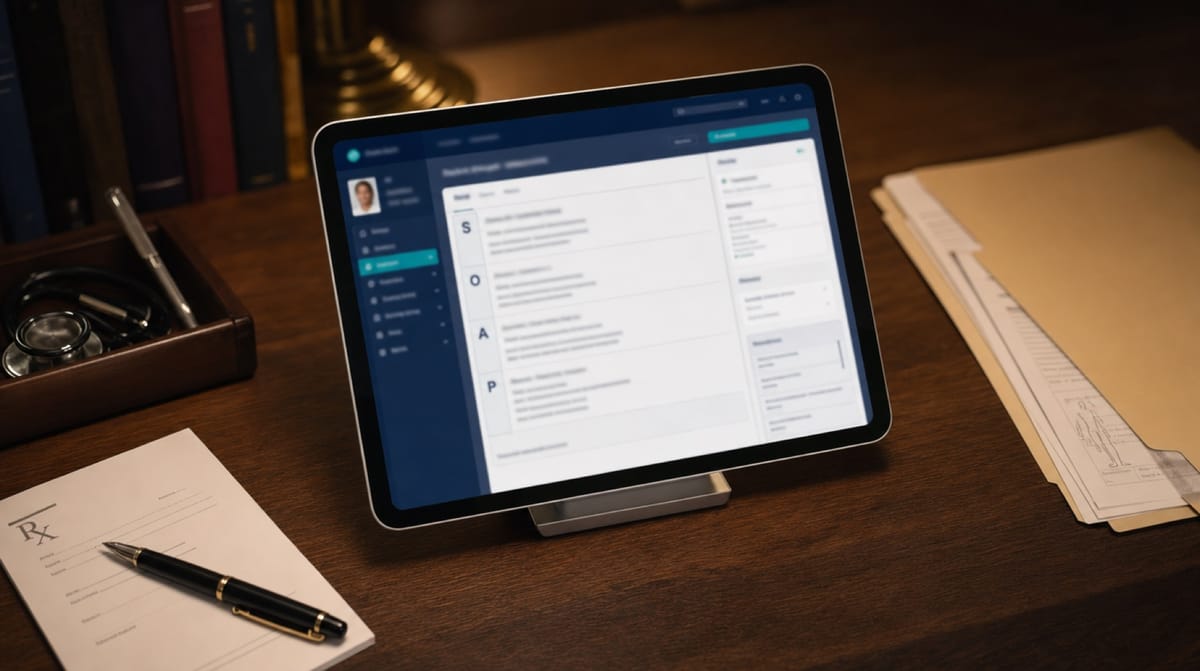
What is an EMR in India, and why are most Indian private clinics still on paper? India's private sector handles approximately 60 to 70% of all outpatient consultations (NSSO 75th Round Health Survey, 2017-18, Ministry of Statistics and Programme Implementation, Government of India), yet most private clinics, from solo GP practices to mid-size multi-specialty facilities, continue to manage patient records on paper. The decision to stay on paper is usually not a principled one. It is a default, sustained by the familiarity of the current system, uncertainty about what EMR adoption involves, and reasonable questions about cost, learning time, and whether the transition is worth it.
This guide answers those questions in plain language. What an EMR is. How it differs from an EHR. What information it captures. What it actually does for a busy outpatient clinic. Why ABDM compliance is making EMR adoption increasingly consequential. And what to look for when you evaluate your options.
An EMR is the digital case file. It captures the same patient history, clinical notes, and prescriptions Indian doctors have always recorded, in a format that is searchable, shareable, and ABDM-compliant. The single operational change paper cannot match is scale: chronic disease tracking, structured follow-up, and clean handoffs across providers. This article works through what that means in practice.
SwasthiQ is building Healthcare Rails for India, the connected ecosystem that links a patient's clinical record across every doctor they see. Your clinic's EMR is the first piece of that infrastructure. This guide is written for clinic owners evaluating EMR, not for software vendors evaluating clinics.
Official sources: ONC EMR vs EHR definition | Saleh et al., BMC Health Services Research 2025, PMC12087044 | PIB ABDM update August 2025, PRID 2155449 | NHA ABDM technical specifications
What Is an EMR?
An EMR, or Electronic Medical Record, is the digital equivalent of the paper case file your clinic has always maintained. Everything that goes into a paper file (the patient's name, age, contact details, presenting complaint, medical history, examination findings, diagnosis, prescription, investigation orders, and follow-up instructions) goes into an EMR instead. The difference is the medium: a structured digital system rather than handwritten sheets in a folder.
The US Office of the National Coordinator for Health Information Technology (ONC), the government body responsible for health IT standards, defines an EMR as a digital version of the paper charts in the clinician's office. It contains the medical and treatment history of patients in one practice, used primarily by clinicians for diagnosis and treatment.
For an Indian GP or specialist running a busy outpatient practice, an EMR is where you create a patient record at first registration and update it at every subsequent visit, recording what the patient came in with, what you found, what you diagnosed, what you prescribed, and when they should return. That is all it is. The sophistication comes from what that structure enables: the ability to search, retrieve, report on, and share that information in ways paper cannot support.
EMR vs EHR: What Is the Difference, and Does It Matter for Your Clinic?
The terms EMR (Electronic Medical Record) and EHR (Electronic Health Record) are frequently used interchangeably in India and globally, which creates unnecessary confusion. The distinction is meaningful, particularly in the Indian context of ABDM.
An EMR is a record maintained within a single practice. It captures what happens in your clinic (your patient's visits, your prescriptions, your findings). It does not automatically travel with the patient to another doctor or hospital. If your patient visits a cardiologist next week, the cardiologist does not have access to your EMR unless you physically share its contents.
An EHR is designed to go further. It is intended to be a more complete, longitudinal health record for the patient across multiple providers and care settings, shareable with explicit consent across the healthcare system. The ONC explains the distinction this way: EMRs are for use by clinicians mostly for diagnosis and treatment, while the broader "health" in EHR covers a lot more territory.
In India, the ABDM framework effectively defines the aspiration for the national health system: every patient has an ABHA ID to which structured health records from every ABDM-connected facility can be linked, creating the longitudinal, portable record that is the functional definition of an EHR. When your clinic's EMR is ABDM-compliant, your consultation records (with the patient's consent) become part of that portable EHR available across the healthcare system.
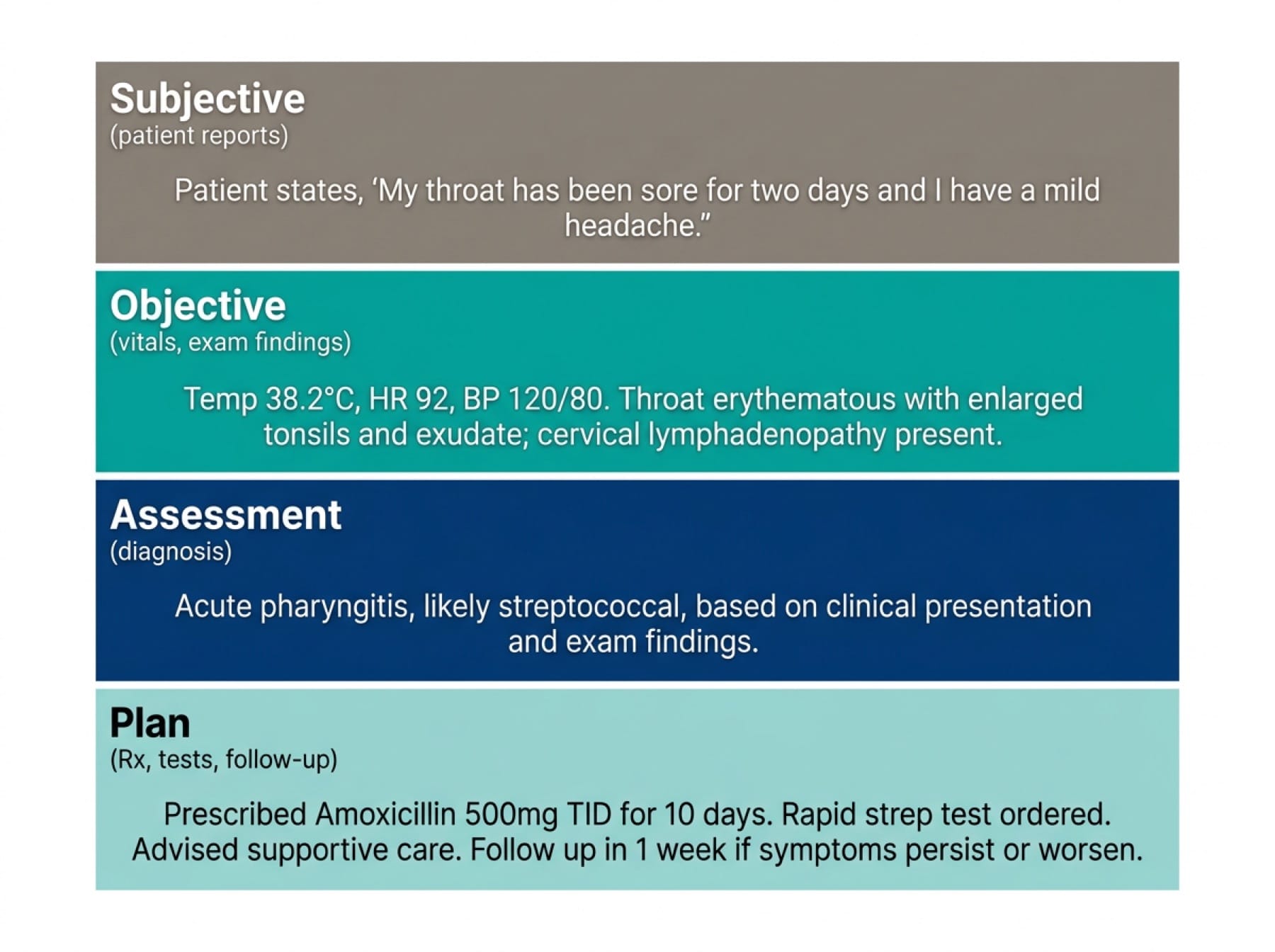
Illustration of an ABHA-linked patient record connecting to clinics, labs, and pharmacies with consent.
For practical purposes, when Indian clinic owners and healthcare software companies use the term EMR, they typically mean the clinic-level system that replaces paper records. Whether your system qualifies as a true EHR depends on whether it supports ABDM integration and structured data sharing. If it does, it functions as both.
What Goes Into an EMR: The Core Records
An EMR for an Indian private clinic contains the following core information categories, which map directly to what currently lives in your paper file system.
Patient demographics: Name, age, date of birth, sex, contact number, address, emergency contact, and ABHA ID if the patient has one. This is created at first registration and updated as needed. In practice, this means the front-desk receptionist captures these once and the doctor never has to re-ask the same baseline questions.
Clinical history: Chief complaint (the reason for the visit, in the patient's words), history of the presenting illness, past medical history (prior diagnoses, conditions, hospitalisations), surgical history, family history, social history (smoking, alcohol, occupation), and allergy information. In a paper system, this is often recorded once and rarely updated. In an EMR, it is structured and searchable.
Examination findings: Vital signs (blood pressure, pulse, temperature, respiratory rate, weight, height, BMI) and examination notes. Structuring vitals as data points rather than text in a note enables trend tracking. You can see at a glance that a patient's systolic BP has gone from 128 to 146 to 158 over three visits, rather than reading through three separate handwritten notes.
Clinical note: The SOAP format (Subjective, what the patient reports; Objective, what you find; Assessment, your diagnosis or differential; Plan, prescription, investigations, follow-up) is the standard structure for EMR consultation notes. This format is familiar to most doctors from medical education. An EMR formalises it into a structured template rather than free-form handwriting.
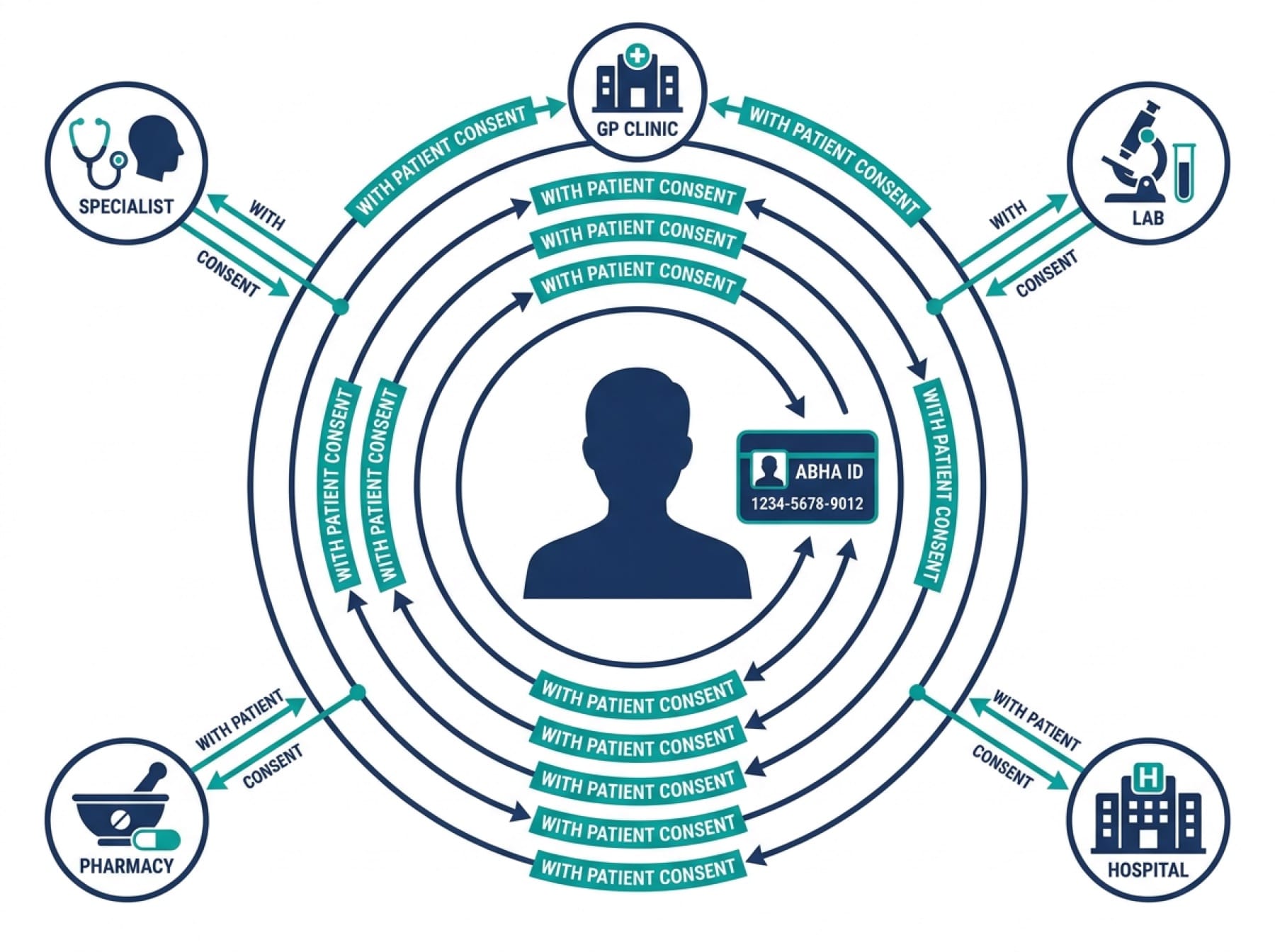
Visual breakdown of the SOAP note format used in EMR consultations, subjective, objective, assessment, plan.
Prescriptions: Digital prescriptions generated within the EMR are legible, reproducible, and automatically part of the patient record. They can be sent to the patient's phone, linked to their ABHA, and shared with a pharmacy. Prescription duplication and handwriting errors, two significant medication safety concerns in India, are substantially reduced.
Investigation orders and results: Tests ordered through the EMR create a structured record of what was requested and when. When lab results return, they can be uploaded and attached to the relevant visit note. The EMR then creates a complete picture: the patient presented with X, you ordered Y, the result was Z, you acted accordingly.
Follow-up and chronic disease management: For patients on long-term management (diabetes, hypertension, thyroid disorders), an EMR creates a structured timeline of every visit, every HbA1c, every BP reading, every prescription change. This is clinically valuable and impossible to replicate practically with paper records in a busy practice.
What EMR Does for Your Clinic That Paper Cannot
A 2025 peer-reviewed study published in BMC Health Services Research (Saleh H, Stålsby Lundborg C, Sharma M, PMC12087044, DOI: 10.1186/s12913-025-12877-5) examined EMR adoption at an 800-bed private tertiary hospital in rural Madhya Pradesh. Despite seeing 1,760 outpatients per day, the hospital was still operating on paper files. The study surveyed 105 postgraduate doctors on their perceived benefits and barriers to EMR implementation. The benefits that doctors identified in that study were: centralised patient data, streamlined clinical workflows, and improvements in quality, efficiency, and patient safety.
In practical terms for an Indian private clinic, these benefits translate to five specific operational improvements.
Reduced documentation time per patient. A well-designed EMR with pre-built templates for common presentations, a drug database for quick prescription generation, and AI-assisted note capture (where available) reduces the time spent writing notes and prescriptions compared to manual documentation. The freed time can be used for the patient.
Elimination of lost and illegible records. Paper records are lost when patients do not bring their file, are illegible when handwriting is difficult, and are unavailable when a second doctor in the clinic needs them simultaneously. An EMR makes every record available to every authorised user at any time.
Chronic disease tracking without manual effort. Your patient with type 2 diabetes has been seen six times in two years. With paper records, reconstructing their HbA1c trajectory requires reading through six separate notes. In an EMR, you see a graph or a structured table. Pattern recognition that drives better clinical decisions happens automatically from structured data.
Automated follow-up and recall. Patients with hypertension who were asked to return in six weeks but did not come back cannot be identified from paper. An EMR can flag patients who are overdue for review and generate follow-up messages (by WhatsApp, SMS, or call) automatically. Recall systems are the backbone of preventive care and chronic disease management. Paper does not support them at scale.
Billing accuracy and revenue tracking. Accurate billing linked to clinical records reduces disputes, prevents missed billing for services rendered, and generates the practice analytics (patient volume, return rate, top diagnoses) that inform business decisions.
ABDM Compliance: Why This Is No Longer Optional
India's Ayushman Bharat Digital Mission (ABDM) has created a national digital health infrastructure built on a single principle: every Indian citizen should have a portable, consent-based health record that follows them across every healthcare provider they visit. As of August 2025, 79.91 crore ABHA IDs have been created and 4.18 lakh health facilities are registered on the Health Facility Registry (HFR), according to PIB press release PRID 2155449.
For private clinic owners, ABDM compliance is becoming consequential on two specific fronts.
What this changes for a typical Indian private clinic is that an EMR is now the entry ticket for two specific revenue and reimbursement streams.
The first is AB-PMJAY participation. The Ayushman Bharat Pradhan Mantri Jan Arogya Yojana (AB-PMJAY), the government's health insurance scheme covering over 55 crore beneficiaries (NHA AB-PMJAY dashboard, 2025), is increasingly integrating ABDM compliance as a condition of participation for empanelled hospitals and clinics. Facilities that want to serve AB-PMJAY patients and receive government reimbursement will face growing pressure to demonstrate digital health record infrastructure.
The second is the Digital Health Incentive Scheme (DHIS). The NHA has disbursed Rs. 73.28 crore in direct financial incentives to clinics, hospitals, and health technology companies for adopting ABDM-compliant digital systems. This incentive structure exists precisely because the government recognises that EMR adoption has upfront costs and is actively offsetting them.
An ABDM-compliant EMR must support ABHA ID creation and verification for patients, register the facility on the Health Facility Registry (HFR), link structured health records to patient ABHAs with consent, implement HL7 FHIR (Fast Healthcare Interoperability Resources) standards for data exchange, and support Scan and Share, the QR code-based paperless OPD registration deployed by the NHA to reduce waiting times. Not every EMR product in the Indian market meets these requirements. Verifying ABDM certification before selecting a system is essential.
Common Concerns from Indian Doctors: Honest Answers
"The initial cost is too high."
The DHIS provides direct financial incentives for EMR adoption. The NHA's declared purpose is to offset the cost of transitioning from paper. Beyond the incentive, the operational efficiency gains from EMR (reduced administrative staff time, improved billing accuracy, automated follow-up) are consistent with the perceived benefits documented in the BMC Health Services Research 2025 review of Indian EMR adoption (Saleh et al., PMC12087044), which found that doctors who adopted EMRs in Indian tertiary settings reported substantial improvements in efficiency and patient safety within the first year. The total cost of paper systems (physical storage, filing staff, paper, the cost of lost records) is also rarely calculated but is substantial over a ten-year period.
"My staff and I don't have time to learn a new system."
This is the most valid concern, and the most dependent on vendor quality. A well-designed EMR built for Indian clinic workflows typically takes a few days to a week of active use for most GPs to reach basic proficiency. The learning curve exists. It is not a permanent barrier. The study at the Madhya Pradesh hospital (PMC12087044) identified staff resistance and training time as the primary implementation barriers, which confirms that implementation support from the vendor, not just software provision, is essential. Ask any EMR vendor for a concrete training and onboarding plan before purchasing.
"Our patients don't use smartphones or digital systems."
An EMR is primarily a tool for the clinic and the doctor. Patients interact with it only if the clinic chooses to send digital prescriptions or reports to them, or if the clinic has an ABHA-linked patient portal. The core functions (documentation, record keeping, prescription generation, follow-up management) operate entirely on the clinic's end, independent of patient digital literacy.
"What if the internet goes down?"
Cloud-based EMRs with offline mode capabilities can function during internet outages and sync when connectivity is restored. Local server-based EMRs operate entirely within the clinic's network. This is a practical infrastructure question to ask vendors directly, not a categorical objection to EMR.
"I'm concerned about data security and patient privacy."
This is a legitimate and important concern. An ABDM-compliant system operates under India's data protection framework and the NHA's security requirements. Patient health records shared through ABDM are consent-based. The patient must explicitly consent before records are accessed by any external provider. Within your clinic, access controls on an EMR can restrict who can view which records. The Information Technology Act 2000 and its rules, and the forthcoming Digital Personal Data Protection Act rules, apply to healthcare data. Ask any EMR vendor specifically about their data storage practices, encryption standards, and audit trail capabilities.
What to Look for in an EMR for an Indian Private Clinic
Not all EMR products are built for the same context. A system designed for a large US hospital group does not meet the workflow, budget, or regulatory requirements of a solo GP practice in Jaipur or a four-doctor specialist clinic in Pune. When evaluating EMR options for your practice, the following criteria matter most in the Indian context.
ABDM certification. Verify that the product is certified by the NHA for ABDM compliance, specifically supporting ABHA creation, HFR registration, health record linking, and FHIR-based data sharing. Ask for the certificate reference, not just a claim.
Clinical workflow fit. The EMR should match how you actually see patients, not how a US software designer imagines you do. Templates for common presentations in your specialty, a quick prescription interface with an Indian drug database, and a note structure that does not require more time than handwriting at your current volume are the minimum requirements.
Prescription generation. The drug database should be comprehensive for the Indian market, covering generic names, brand names, common formulations, and standard Indian dosing conventions.
Multi-device access. A clinic doctor who moves between a laptop at the desk and a tablet in the examination room, or who reviews reports at home, needs a system accessible across devices without reinstalling software.
Implementation support. Software without onboarding and ongoing support is not a viable solution for a busy clinic. Confirm what training is provided, what the ongoing support channel is, and what the vendor's response time is for technical issues.
Price transparency and billing integration. Understand the full pricing (subscription fee, per-patient charges if any, implementation costs) and whether billing and accounts integration is included or an add-on.
For context, SwasthiQ builds Kaagazy EMR for this market. Whether you evaluate Kaagazy or another product, the criteria above are the ones that matter.
Scale and ABDM Compliance: Why EMR Now Pays Back Twice
The argument for moving off paper has two halves, and they reinforce each other.
The first half is operational scale. Paper records cannot support chronic disease tracking across multiple visits in any practical way. They cannot generate automated follow-up. They cannot give a doctor a glanceable trend of a patient's blood pressure or HbA1c. An EMR does all three. For a clinic that sees 30 or more patients a day, the per-patient time saved on documentation, prescription generation, and follow-up adds up to several reclaimed clinical hours a week.
The second half is ABDM compliance. NHA's DHIS incentive directly offsets EMR adoption cost. AB-PMJAY empanelment is moving toward ABDM-compliant facilities as the default. The Health Facility Registry is now the gateway through which Indian private clinics will be discovered by patients using the ABHA app and Scan and Share. A clinic on paper is invisible to that infrastructure.
Together, the operational scale advantage of digital records and the regulatory and financial advantage of ABDM compliance turn EMR adoption from a discretionary upgrade into the operational baseline for any Indian private clinic that wants to serve patients well, capture government incentives, and stay visible inside the national digital health system.
Action This Week
Pick one. Shortlist three EMR vendors and ask each for written confirmation of NHA ABDM certification (specifically: ABHA creation, HFR registration, FHIR R4 support, Scan and Share). Calculate your current paper-system cost over the past year (filing staff time, physical storage, lost-file incidents, prescription-error returns) so you can compare it to EMR pricing on a like-for-like basis. Apply for the Digital Health Incentive Scheme (DHIS) registration on the NHA portal to understand what financial offset is available before you commit to a vendor.
Stay updated on digital health for Indian clinics
SwasthiQ publishes evidence-based content on clinical software, ABDM compliance, and the future of Indian healthcare for clinic owners and doctors. Subscribe for monthly updates.
Think Care · Think SwasthiQ
Related reading: ABDM explained: what India's digital health mission means for your clinic | EMR vs paper documentation: what the time-and-error data actually shows | What going to the doctor in India should feel like in 2026