Tuberculosis in India: Why We Are Still Fighting a 19th-Century Disease in 2026
India accounts for 25% of the world's TB cases. The 2015-2024 incidence decline of 21% is the fastest among high-burden countries, yet the 2025 elimination target was missed. NTEP, BPaLM, drug-resistant TB, and the structural drivers India still needs to address.
Note: This article is for informational purposes only. If you have symptoms consistent with tuberculosis, consult a doctor promptly. TB is curable when detected and treated early. Do not self-medicate.
Robert Koch identified Mycobacterium tuberculosis, the bacterium that causes tuberculosis (TB), in 1882. Effective antibiotic treatment became available in the 1940s. The disease has been curable for eight decades. And yet, in 2026, India still accounts for 25% of all tuberculosis cases on Earth, making it the country with the single largest TB burden in the world.
This is not a story of failure. India has made genuine, documented, and internationally recognised progress. The WHO Global Tuberculosis Report 2025 confirmed that India's TB incidence dropped by 21% between 2015 and 2024, from 237 cases per lakh population to 187, at almost double the rate of decline observed globally. Deaths due to TB in India fell by 28% over the same period. No high-burden country has reduced its TB burden faster.
And yet. India set itself a target of eliminating TB by 2025, five years ahead of the global 2030 goal. That target was not met. The elimination threshold is below 44 cases per lakh. The 2024 figure is 187. The gap is large. The question this article addresses is not whether progress has been made, because it has, but why a curable, preventable, and well-understood disease continues at this scale, what the remaining structural drivers are, and what India's current strategy is doing to close the gap.
India has achieved the fastest decline in TB incidence of any high-burden country, but the 2025 elimination target was missed because TB's structural drivers including malnutrition, drug resistance, private sector gaps, and overcrowding have not been fully addressed. Understanding this gap is the starting point for understanding what still needs to change.
SwasthiQ is building Healthcare Rails for India, the connected ecosystem that links TB diagnosis, treatment, follow-up, and nutrition support across public and private providers so a patient who first seeks care at a private clinic is tracked, supported, and notified into NTEP rather than lost to a fragmented care pathway.
Official sources: PIB press release, March 2026 (PRID 2244661) | WHO Global TB Report 2025 | Zumla and Sahu et al., IJID Regions, 2025 | Yadav, Cureus, 2024
What Is Tuberculosis?
Tuberculosis is a bacterial infectious disease caused by Mycobacterium tuberculosis. It spreads through the air. When a person with active pulmonary (lung) TB coughs, sneezes, or speaks, they expel microscopic droplets containing the bacteria, which can be inhaled by others in the same space. This airborne transmission mechanism is what makes TB so persistent in densely populated environments. Prolonged close contact with an infectious person, in a poorly ventilated space, is the most common route of transmission.
The disease primarily affects the lungs (pulmonary TB). Extrapulmonary TB can affect almost any other organ, including the lymph nodes, bones, spine, kidneys, brain (tuberculous meningitis), and intestines. The WHO notes that people with lung TB generally stop being contagious after at least two weeks of appropriate antibiotic treatment, which is one of the strongest arguments for early diagnosis and prompt treatment initiation.
Not everyone who inhales TB bacteria develops active disease. The immune system can contain the bacteria in a latent state, known as latent TB infection (LTBI), in which the bacteria are present but dormant and the person has no symptoms and is not infectious. Roughly one-quarter of the world's population is estimated to have LTBI, per WHO epidemiological estimates. This reservoir of latent infection is why TB persists even in settings where active cases are declining. Reactivation of latent TB, often triggered by immune suppression from HIV, diabetes, malnutrition, or immunosuppressive treatment, continues to generate new active cases.
India's TB Burden: The Scale in 2026
India's TB statistics are significant enough to state plainly and in context. India accounts for 25% of all TB cases worldwide, the highest national share of any country. Approximately 27 lakh (2.7 million) TB cases were reported in India in 2023, against an 89% treatment coverage rate. India also carries the world's largest burden of drug-resistant TB.
To contextualise what these numbers represent: TB remains one of the leading infectious causes of death globally, responsible for an estimated 1.25 million deaths in 2023. India's share of that burden means that hundreds of thousands of Indians die from a treatable infection every year. This is not a disease that people die from because medicine cannot cure it. It is a disease that people die from because of delayed diagnosis, inadequate treatment adherence, drug resistance, and the structural conditions that make all three more likely.
India's TB burden is disproportionately concentrated in specific populations. Malnutrition is the single largest TB risk factor in India: people who are undernourished have a substantially elevated risk of progressing from latent to active TB because an intact immune response is what contains the bacteria. Overcrowding, poor ventilation, and living in shared spaces all increase transmission risk. People with diabetes, HIV, or those taking immunosuppressive medications face elevated reactivation risk.
The 2025 Target: What Was Achieved and What Was Not
In 2018, Prime Minister Narendra Modi committed India to eliminating TB by 2025, five years ahead of the global SDG target of 2030. India's TB budget increased from US$106 million in 2015 to over US$500 million by 2020, a five-fold increase, according to research published in IJID Regions in 2025 (Zumla and Sahu et al., PMC11973646). The National TB Elimination Programme (NTEP), renamed from the Revised National Tuberculosis Control Programme (RNTCP) in 2020, became the operational vehicle for this accelerated effort.
The progress has been real. The 21% decline in incidence and 28% decline in TB deaths between 2015 and 2024 represent the fastest improvement among all high-burden countries. The WHO Global TB Report 2025 confirmed India's TB decline as among the most significant globally.
But elimination, as defined by WHO's End TB strategy, means reducing TB incidence to below 10 cases per 100,000 population (10 per lakh). India's 2025 national target was a more modest intermediate milestone: below 44 per lakh. India's 2024 incidence is 187 per lakh. The gap between the current trajectory and the elimination threshold is substantial. India's 2025 goal was not met, and the WHO report characterised India's progress as substantial but insufficient for the accelerated timeline.
Drug-Resistant TB: The Crisis Within the Crisis
Within India's TB burden, drug-resistant TB represents the most complex and urgent challenge. Drug-resistant TB arises when the bacteria causing TB develop resistance to the antibiotics used to treat it, a process that is significantly accelerated by incomplete or inadequately supervised treatment. Once resistance develops, the treatment options become fewer, more expensive, more toxic, and longer in duration.
India has the highest global burden of MDR-TB (multidrug-resistant TB, meaning TB caused by bacteria resistant to at least isoniazid and rifampicin, the two most important first-line anti-TB drugs given for 6 months in standard treatment), accounting for 32% of global MDR/RR-TB cases (MDR plus rifampicin-resistant TB, the WHO's combined surveillance category for the most clinically difficult-to-treat strains) according to the WHO Global TB Report 2025. Among new TB cases in India, 2.8% have MDR-TB. Among previously treated cases, 12% have MDR-TB, according to Yadav S, Cureus, September 2024 (PMC11445631). The estimated MDR-TB incidence in India is approximately 135,000 cases per year, the highest of any country.
Until recently, treating MDR-TB required 18 to 24 months of treatment with a cocktail of multiple drugs, many of which carry significant side effects including hearing loss, liver toxicity, and psychiatric effects. Treatment adherence over such a long duration is challenging. Poor adherence is itself a driver of further resistance.
The BPaLM Revolution: India's New Weapon Against Drug-Resistant TB
The most significant recent development in India's fight against drug-resistant TB is the approval and rollout of the BPaLM regimen. BPaLM stands for Bedaquiline, Pretomanid, Linezolid, and Moxifloxacin, an all-oral, four-drug combination that replaces the conventional 18 to 24-month MDR-TB regimen with a six-month course. The Union Ministry of Health and Family Welfare approved the introduction of BPaLM under NTEP on September 6, 2024 (PIB PRID 2052515).
The clinical evidence supporting BPaLM comes from three landmark trials that informed WHO's 2022 recommendation: Nix-TB, ZeNix, and TB-PRACTECAL. These trials demonstrated treatment success rates exceeding 90% in highly resistant strains. The TB-PRACTECAL trial, the most directly relevant to the BPaLM (four-drug) combination, reported a 12-month treatment success rate of 89% compared with 52% in the control arm (Nyang'wa et al., The Lancet, 2022, DOI: 10.1016/S0140-6736(22)01947-5). These outcomes are substantially better than conventional long-duration regimens achieved in practice.
For India, the practical implications are significant. Reducing treatment duration from 18 to 24 months to six months dramatically improves adherence rates and reduces the period during which patients can transmit the disease. The all-oral format removes the need for daily injections, which were associated with serious side effects including permanent hearing loss and were a major driver of treatment interruption. The WHO Global TB Report 2025 noted, however, that India was still using longer (18 to 20 month) regimens for more than half of MDR-TB patients in 2024, indicating that BPaLM rollout, while approved, is not yet the operational default for all eligible patients.
The National TB Elimination Programme: India's Response Architecture
India's NTEP is the operational framework through which all TB elimination activities are conducted. The March 2026 PIB press release (PRID 2244661) detailed the current infrastructure and reach.
Diagnostic infrastructure: India has built the world's largest network of rapid molecular TB diagnostic facilities, with over 9,800 CBNAAT/TrueNat (cartridge-based and chip-based nucleic acid amplification tests that detect TB DNA in a sputum sample within two hours, replacing the older microscopy method that took days) testing points and 107 culture and drug susceptibility testing laboratories.
AI-powered screening: Over 500 AI-enabled handheld chest X-ray units are deployed for community screening, with an additional 1,500 units in the process of delivery to states and union territories.
Ni-kshay digital platform: Ni-kshay is India's national digital platform for TB management. It enables real-time notification of TB cases, tracks patient treatment journeys, and facilitates the Ni-kshay Poshan Yojana, the Direct Benefit Transfer scheme that provides financial nutritional support directly to TB patients' bank accounts.
Ni-kshay Mitra: A community volunteer programme in which individuals, organisations, and corporate entities can adopt and support TB patients by providing nutritional, diagnostic, and vocational support.
PM TB Mukt Bharat Abhiyan: A mass movement launched in 2022 focused on early detection, community participation, and patient support across India's TB ecosystem.
Ayushman Arogya Mandirs: As of March 2026, India's 1,84,726 Ayushman Arogya Mandirs function as primary points for TB symptom identification and referral.
The Nutrition-TB Nexus: India's Specific Challenge
Malnutrition is the single largest risk factor for TB globally, and in India, where protein-energy malnutrition and micronutrient deficiencies remain widespread, this relationship is directly relevant to why elimination is harder to achieve.
Malnutrition impairs the immune response that normally contains latent TB infection. When the immune system is compromised by insufficient protein, zinc, vitamin D, or other nutrients, latent TB is more likely to reactivate into active disease. TB itself causes loss of appetite, weight loss, and nutrient depletion, creating a cycle in which the disease worsens its own underlying driver.
This is why the Ni-kshay Poshan Yojana is not merely a welfare measure. It is a clinical intervention. TB patients who receive adequate nutritional support have better treatment outcomes, reduced transmission duration, and lower rates of treatment failure.
The Private Sector Problem
India's private healthcare sector is the destination for 60 to 85% of initial tuberculosis care-seeking, according to a peer-reviewed study published in Tropical Medicine and Infectious Disease (PMC9295336, 2022). These patients may encounter general practitioners, chemists, or AYUSH practitioners rather than NTEP-aligned diagnostic and treatment pathways. Private sector TB care in India has historically been associated with inconsistent diagnostics, prescription of inadequate treatment regimens, absence of mandatory case notification, and limited adherence support.
The consequence is a significant portion of India's TB burden that is diagnosed and treated outside standardised protocols, creating conditions for treatment failure, resistance development, and incomplete epidemiological tracking.
The NTEP's private sector engagement strategy involves free drug provision to private practitioners under JEET (Joint Effort for Elimination of Tuberculosis, the partnership programme that funds free anti-TB drugs and patient support for private-sector TB cases that are properly notified to the government) and mandatory notification requirements. Progress has been made: private sector TB notifications have increased substantially over the last decade. But the quality gap between public NTEP-aligned care and fragmented private sector care remains one of the most important structural challenges.
What Every Indian Should Know About TB
TB is common, TB is curable, and TB carries unnecessary stigma that delays people from seeking care.
The common symptoms of pulmonary TB are a cough lasting more than two weeks, coughing blood or blood-stained sputum, unexplained fever particularly in the evening or at night, night sweats, unexplained weight loss, fatigue, and loss of appetite. Persistent cough lasting beyond two weeks in any Indian adult is a reason to seek diagnostic evaluation.
TB testing is free at all government health facilities under NTEP. The CBNAAT/TrueNat test provides a diagnosis and rifampicin resistance result within hours. Treatment is free, including first-line drugs and the new BPaLM regimen for eligible drug-resistant patients.
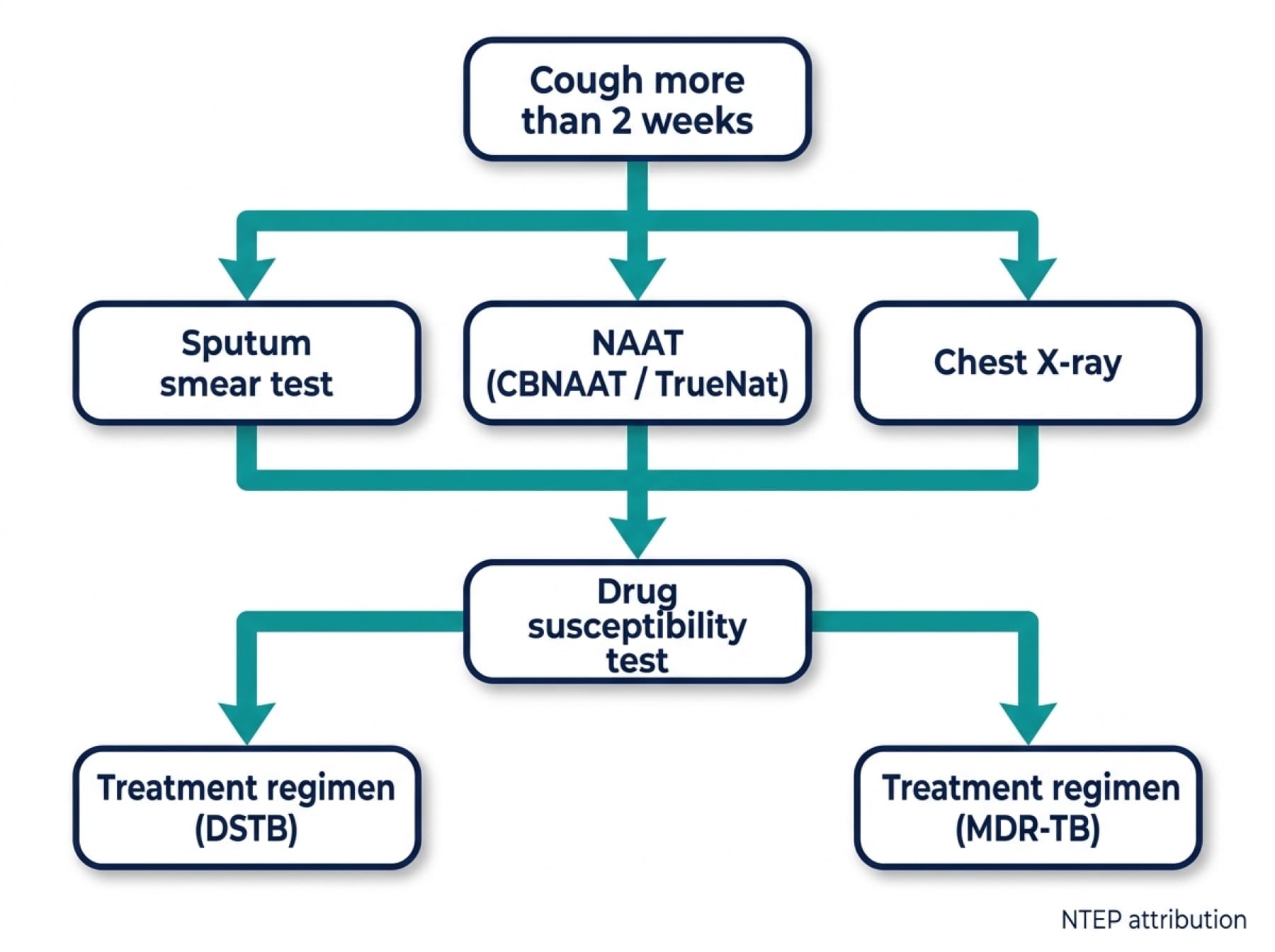
Flowchart of India's TB diagnostic pathway from symptom onset to treatment regimen selection.
Completing the full treatment course is essential. Incomplete treatment is the primary mechanism through which drug resistance develops and spreads.
See our guide on important annual health tests for Indian adults for more context on when and where to get tested.
The Bottom Line
TB is a 19th-century disease in the sense that its cause was identified in the 1880s and its cure was developed in the 1940s. It is a 21st-century problem in India because the conditions that sustain it (poverty, malnutrition, overcrowding, and a healthcare system still building its reach) remain present at scale.
India has made more progress against TB, faster, than any other high-burden country. The 21% incidence decline and 28% mortality reduction between 2015 and 2024 are not small achievements. The five-fold increase in the TB budget, the world's largest molecular diagnostic network, the rollout of the BPaLM regimen, the Ni-kshay digital platform, and the community-level screening infrastructure represent a serious, evidence-backed national effort.
The 2025 elimination target was not reached. But the infrastructure, the political commitment, and the clinical tools now exist to continue the trajectory.
Action This Week
If you have had a cough for more than two weeks, especially with unexplained fever, night sweats, or weight loss, go to any government health facility and ask for a free CBNAAT or TrueNat TB test. If you live with someone who has been diagnosed with TB, ask the treating clinic about household contact screening, which is part of NTEP protocol. If you are in a position to support TB patients through Ni-kshay Mitra (financial, nutritional, or vocational), register at nikshay.in.
Stay informed on public health in India
SwasthiQ covers TB, AMR, women's health, and preventive care evidence for Indian patients and clinic owners. Subscribe to our monthly newsletter: evidence-based, no hype.
Think Care · Think SwasthiQ
Related reading: India's antimicrobial resistance crisis: why your antibiotics may stop working | ABDM explained: what India's digital health mission means for your clinic | Important annual medical tests every adult in India should know