Cancer and AI in India: What Is Actually Deployed Right Now
In 2026, AI cancer detection is live in Indian public hospitals, not just private labs. What is actually operational versus still a pilot, covering http://iOncology.ai, MP radiology, and Telangana lung screening.
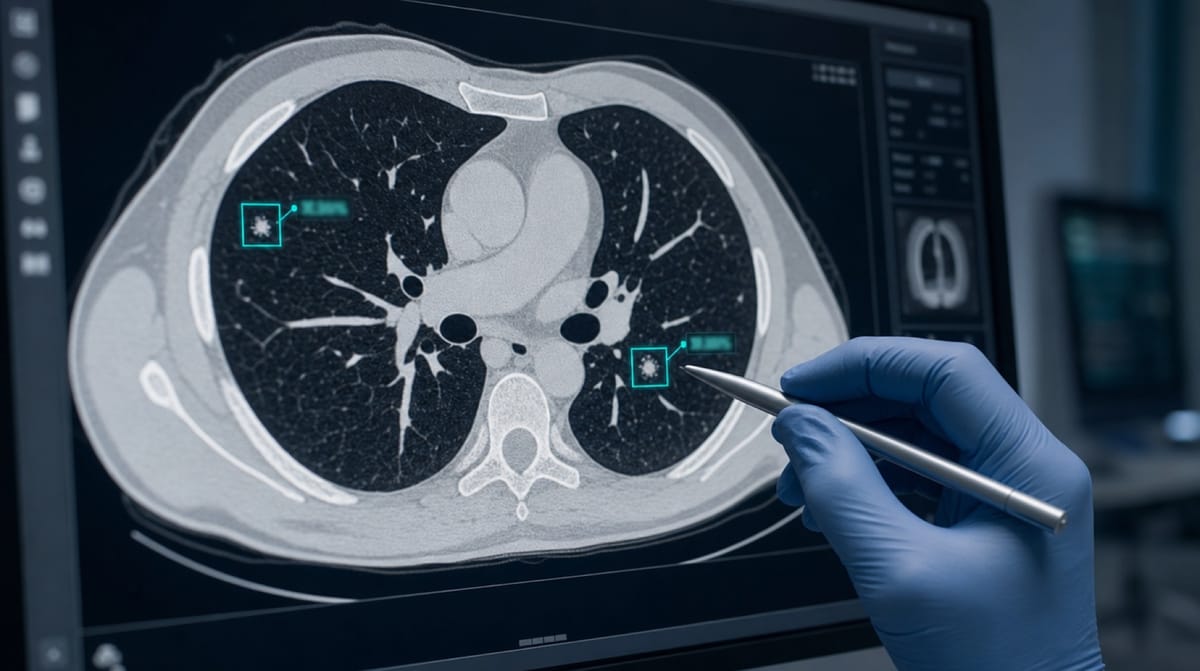
In Madhya Pradesh, AI-powered radiology systems are analysing CT scans in district hospitals. In Telangana, an AI lung cancer screening programme is running across public health facilities. At AIIMS New Delhi, a platform trained on 500,000 images is detecting breast and ovarian cancer at early stages, and has already been deployed to hospitals in five states. None of this is a future roadmap. It is live today.
The question most people do not ask is the right one: what is actually operational, and what is still a pilot? For every genuine deployment of AI cancer detection in India, there are a dozen vendor press releases describing trials that quietly ended. This article draws that line.
AI cancer detection in India in 2026 is operational at district hospital scale. The three deployments to understand are iOncology.ai, the MP radiology rollout, and the Telangana lung screening programme. Here is the evidence behind each, and what separates them from everything still in the pilot column.
SwasthiQ covers India's health-tech landscape as part of its work digitising Indian clinic workflows. This article draws on published government sources, peer-reviewed research, and verified media coverage. Claims that could not be source-verified have been removed rather than softened.
Official sources used in this article: IndiaAI Mission | PIB press releases | arXiv:2504.00022 | Frontiers in Digital Health, March 2025 | Healthcare IT News, April 2025
The State of AI Cancer Detection in India: A Reality Check
Between 2022 and 2025, India began integrating AI into its public health systems at meaningful scale, not just as isolated experiments, but as part of coordinated national and state strategy.
The IndiaAI Mission, approved by the Cabinet on March 7, 2024, with a budget of Rs. 10,372 crore over five years, provides the infrastructure backbone: compute, datasets, and AI application development across sectors including healthcare. (PIB, March 2024)
Within oncology specifically, this has produced three distinct tiers of deployment: tools that are operational in real hospitals today, tools in active validation across a handful of sites, and tools that remain research-grade or limited to single-institution pilots. The rest of this article covers each tier, starting with what is unambiguously live.
AI Radiology in India: The Frontline of Deployed Cancer Detection
If there is one area where AI cancer detection in India has moved from pilot to operational, it is radiology. Radiology has the clearest implementation pathway: AI models process imaging data, produce a report or flag, and integrate into existing PACS (Picture Archiving and Communication System) and RIS (Radiology Information System) workflows without requiring a full clinical process redesign.
AI-powered imaging in public district hospitals. AI-enabled radiology systems have moved beyond private hospital networks into government infrastructure. In Madhya Pradesh, mlHealth360's cloud-based AI platform has been deployed across district hospitals to analyse and triage abnormalities in CT scans and generate standardised radiology reports, integrated with existing PACS and RIS systems to support clinical workflows. (Healthcare IT News, April 2025)
These systems are embedded into hospital imaging workflows. They are not standalone tools accessed via a separate interface. This is a material shift from the previous model where AI radiology was available only in tier-1 private hospitals. Embedding in public district hospitals means the technology is being stress-tested against the volume, equipment variability, and connectivity constraints of India's real healthcare infrastructure.
AI imaging at scale: the evidence base. A 2025 study published on arXiv (paper 2504.00022), deployed across 17 major healthcare systems in India including government hospitals, processed over 150,000 scans, averaging 2,000 chest X-rays daily, with up to 98% precision for multi-pathology classification and significant reductions in reporting time. (arXiv:2504.00022, April 2025)
For oncology, the direct implications are earlier tumour detection, faster triaging of suspicious scans, and reduced diagnostic delays in settings where radiologist density is low.
Lung Cancer Screening: State-Level Deployment in Telangana
One of the most concrete cancer-specific AI deployments in India is in lung cancer screening. Telangana has rolled out AI-enabled lung screening programmes in public health facilities, using imaging analysis to identify early-stage lung abnormalities. (Healthcare IT News, April 2025)
This matters because lung cancer is among India's deadliest cancers and is routinely detected late. Population-scale AI screening in a state government programme, leveraging existing public health infrastructure, represents a direct step toward closing that detection gap. This is not a pilot in the traditional sense. It is an operational programme running across facilities.
iOncology.ai: India's Most Documented Cancer AI Deployment
The most fully documented AI cancer detection deployment in India is iOncology.ai, developed by AIIMS New Delhi in collaboration with the Centre for Development of Advanced Computing (CDAC), Pune, under the Ministry of Electronics and Information Technology (MeitY).
What the platform does. Launched in February 2024, iOncology.ai uses deep learning models trained on approximately 500,000 radiological and histopathological images from 1,500 patient cases at AIIMS. Its initial focus is breast and ovarian cancer, the most common cancers among women in India. The platform analyses imaging and clinical data to support early detection and treatment planning. (ANI / AIIMS official statement, February 2024 | Healthcare IT News, February 2024)
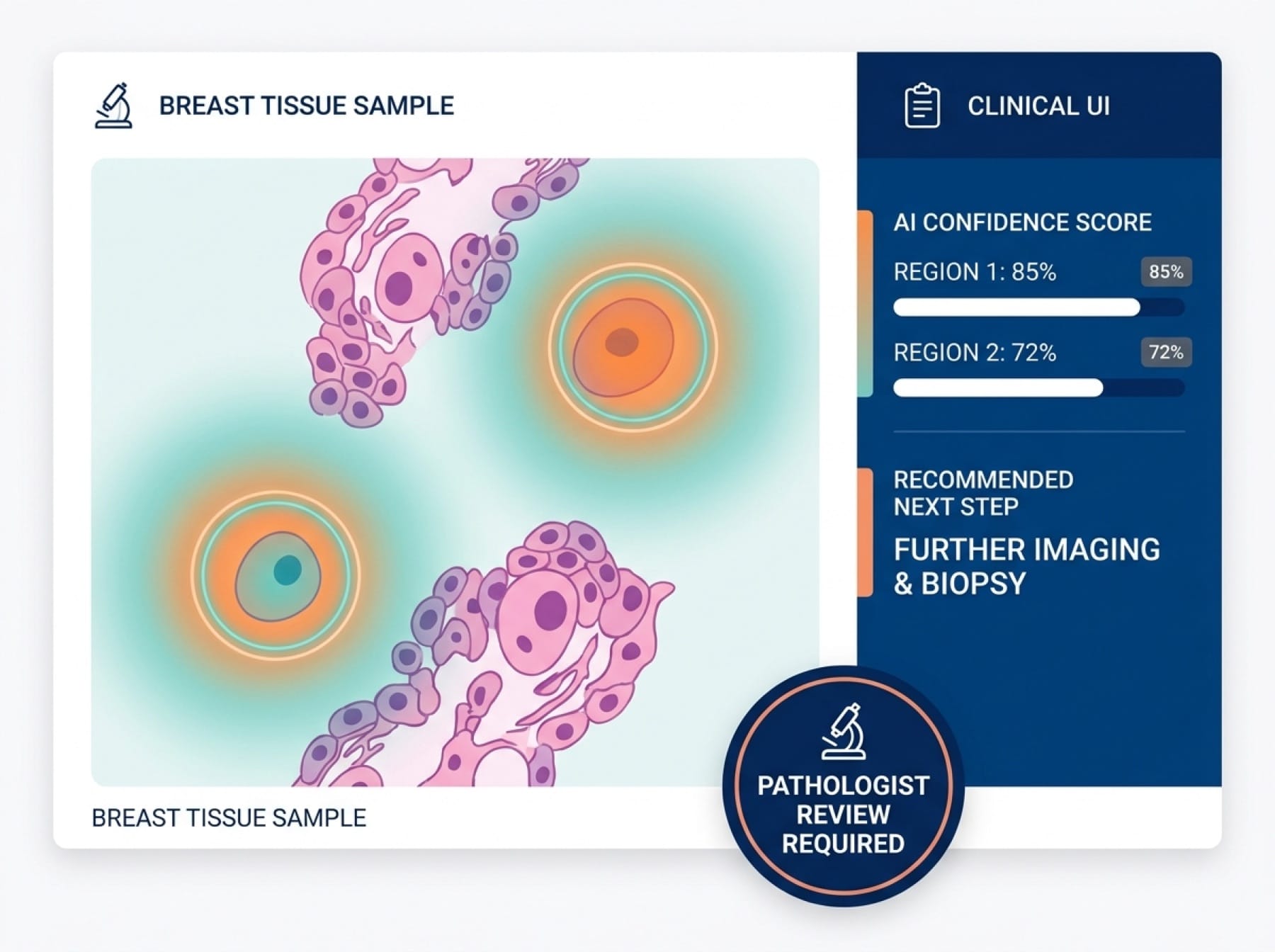
AI heat map overlay on a breast tissue histopathology slide flagging regions for pathologist review
Scale of deployment. As of the IndiaAI Summit in July 2024, MeitY confirmed that iOncology.ai had been deployed across hospitals in seven districts spanning five states: Rajasthan, Madhya Pradesh, Uttar Pradesh, Delhi, and Gujarat. Plans for further partnerships with cancer hospitals and research centres are in progress. As an indigenously developed technology under MeitY, scale-up through National Informatics Centres is the stated pathway. (Drug Today Online, IndiaAI Summit 2024)
Why iOncology.ai is the deployment to watch. It is significant for two reasons beyond its detection capability. First, it is a government-built platform, not a vendor sale, meaning cost and IP barriers to national scale-up are substantially lower than a commercial deployment. Second, its self-learning architecture means diagnostic accuracy improves as more data is ingested from the district hospital network it is now embedded in. (Frontiers in Digital Health, March 2025)
The Infrastructure Layer: IndiaAI Mission and the National Cancer Grid
The deployments above do not exist in isolation. Two structural programmes provide the coordination layer that makes district-level deployment possible.
IndiaAI Mission. The IndiaAI Mission, launched March 7, 2024, with a Rs. 10,372 crore budget over five years, provides three things critical to AI oncology deployment:
- Subsidised access to GPU compute (over 38,000 GPUs onboarded, available at Rs. 65 per hour).
- A Dataset Platform for high-quality health data access.
- Direct application development support for India-specific healthcare challenges.
(PIB, October 2025) The government has also established an AI Centre of Excellence for healthcare in New Delhi as part of this mission. (Principal Scientific Adviser, Government of India)
National Cancer Grid. The National Cancer Grid actively funds real-world AI oncology solutions and connects hospitals across India to standardise cancer care pathways. NCG functions as the clinical coordination layer, ensuring AI tools are not isolated pilots but part of a network where learnings and data can be shared across institutions.
Deployed vs Pilot: The Line Drawn Clearly
This is the table that matters most for anyone evaluating AI cancer detection in India in 2026.
| Operational today | Still in pilot or emerging |
|---|---|
| AI radiology in public district hospitals (MP, Telangana) | Fully autonomous oncology clinical decision systems |
| Lung cancer screening programme, Telangana state | Large-scale genomics-driven AI for personalised treatment |
| iOncology.ai, 7 districts across 5 states (MeitY / AIIMS / CDAC) | Nationwide AI cancer screening programmes |
| arXiv multi-pathology imaging deployment across 17 systems (150,000+ scans, up to 98% precision) | AI-guided robotic surgery at scale |
Four Challenges Slowing Wider Adoption
Real progress does not mean the path is smooth. Four challenges consistently appear in academic reviews and on-the-ground reports.
Data fragmentation. India lacks unified, high-quality cancer datasets across institutions. Each hospital's imaging and clinical data sits in siloes. iOncology.ai's self-learning model partly addresses this within the MeitY/AIIMS network, but the broader fragmentation remains unresolved.
Workflow integration. AI tools must fit into existing hospital systems (PACS, RIS, HIS, EMR) without adding steps to the clinical workflow. Embedding is still uneven: some deployments are tightly integrated; others require separate logins or manual image upload, reducing clinical adoption regardless of diagnostic accuracy.
Clinical validation and trust. Clinicians require robust validation against Indian patient populations before relying on AI outputs for diagnostic decisions. The iOncology.ai dataset of 1,500 cases and 500,000 images is a meaningful start, but the medical community will require peer-reviewed, multi-centre validation studies before broad adoption. (Frontiers in Digital Health, March 2025)
Infrastructure gaps in non-metro settings. AI radiology requires reliable connectivity and compatible imaging hardware. Tier-2 and tier-3 deployments increasingly demonstrate that this is solvable, but it remains the binding constraint for any national rollout.
What This Means for India: The Bigger Picture
The evidence supports one central conclusion: AI cancer detection in India is operational at district hospital scale, not experimental. The question is no longer whether it is happening, but how fast it scales.
India's approach is distinctive in three ways:
- Scalable through public infrastructure: not limited to premium private chains.
- Cost-sensitive by design: indigenously built tools like iOncology.ai avoid vendor licensing barriers at national scale.
- Policy-integrated: IndiaAI Mission, ABDM, and NCG coordination mean deployments feed into shared infrastructure rather than operating as isolated experiments.
This is particularly relevant for oncology. Early detection and geographic accessibility are the two variables that most dramatically impact cancer survival rates in India. AI that works at district hospital scale, even imperfectly, addresses both in ways that high-cost precision medicine tools do not.
Final Thoughts
The story of AI cancer detection in India in 2026 is not about futuristic breakthroughs. It is about pragmatic, documented deployment at public health scale.
AI radiology is transforming diagnostics in public hospitals in at least two states. AIIMS and CDAC have built and deployed an AI cancer detection platform across seven districts in five states. State governments are running real AI-enabled cancer screening programmes. And the IndiaAI Mission is providing the GPU compute and data infrastructure that lets these deployments scale.
The three deployments to track are iOncology.ai, the MP radiology rollout, and the Telangana lung screening programme. Everything else is either earlier-stage validation or infrastructure build-out that will enable the next tier.
AI cancer detection in India is no longer experimental. It is operational.
Stay informed on AI in Indian healthcare
Subscribe to SwasthiQ's health-tech newsletter for evidence-based updates on AI in Indian healthcare: monthly, no hype, no vendor press releases.
Think Care · Think SwasthiQ
Related reading: What is ABDM and ABHA? India's Digital Health Mission Explained | EMR vs Paper Documentation: A Real-World Comparison for Indian Private Clinics | AI in Medical Education: How India Is Training the Doctors of Tomorrow