Why Indian Women Are Having Heart Attacks Younger Than Ever
From 2000 to 2017, ischaemic heart disease mortality in Indian women rose 93.7%, faster than in Indian men. INTERHEART found hypertension and diabetes are more dangerous risk factors for younger Indian women than men. PCOS, pregnancy complications, and atypical symptoms explained.
Important: This article is for informational purposes only and does not constitute medical advice. If you are experiencing symptoms including chest tightness, unexplained fatigue, shortness of breath, nausea, or pain in the back, jaw, or arm, call 112 or get to an emergency department immediately. Do not self-diagnose. If you are at risk for heart disease, consult a cardiologist.
Between 2000 and 2017, ischaemic heart disease (IHD) mortality among Indian women increased by 93.7%, according to an analysis of Global Burden of Disease 2017 data published in a peer-reviewed journal. Men's IHD mortality also rose over the same period, but at a lower rate. The data is not ambiguous. Indian women's cardiac mortality is rising faster than men's, and the gap between expectation and reality has become a public health problem.
In 2017, cardiovascular disease caused 2.64 million deaths in India. Women accounted for 1.18 million of those deaths, men for 1.45 million. Ischaemic heart disease alone killed approximately 0.62 million Indian women and 0.92 million Indian men in that year. These are not small numbers. They establish heart disease as a leading cause of death in Indian women, not a secondary concern, and not a condition that disproportionately spares women until they are elderly.
Indian women's ischaemic heart disease mortality is rising nearly twice as fast as Indian men's, driven by diabetes and hypertension that are uniquely more dangerous for younger Indian women than for men, compounded by PCOS, pregnancy-related cardiovascular risks, and the South Asian thin-fat phenotype, and amplified by a persistent assumption in both clinical practice and public awareness that heart disease is primarily a male condition. This article works through the evidence.
SwasthiQ is building Healthcare Rails for India, the connected ecosystem that links a woman's gynaecology record, pregnancy history, lab results, and cardiac risk profile so a pre-eclampsia event in her 20s is something her cardiologist sees twenty years later, not a fact buried in an unconnected medical history. Women's cardiac risk does not belong in a siloed gynaecology folder. It belongs in a connected health record.
Official sources: Vijayalakshmi IB et al., Indian J Cardiovasc Dis Women, 2023 | Kundu et al., BMC Public Health 2023, PMC10035272 | INTERHEART via ICMR, PMC1993956 | PMC3953680, Asian Indian CVD risk factors
The Myth That Is Killing Indian Women
Heart disease has been culturally and clinically framed as a male disease for most of the modern medical era. The foundational studies of cardiovascular disease, including the Framingham Heart Study that began in 1948 and established the core understanding of heart disease risk factors and pathophysiology, were conducted predominantly on male subjects. The female cardiovascular system was understood largely through its differences from the male model, and the prevailing framework was that women are protected from heart disease before menopause by oestrogen's beneficial effects on lipid metabolism and vascular function.
This framework was partially correct for Western women in Western clinical contexts. It has been disastrously wrong for Indian women, and for reasons that were predictable had the research included adequate South Asian female representation.
A 2023 peer-reviewed review published in the Indian Journal of Cardiovascular Disease in Women by Vijayalakshmi et al., with authorship including ICMR-affiliated researchers, documents that coronary artery disease is now the leading cause of death among Indian women. Heart disease accounts for more than 40% of all deaths in women. A systematic review of CVD risk factors in Asian Indians (PMC3953680) found that approximately 25% of acute myocardial infarctions (MI, the medical term for a heart attack, when blood flow to a part of the heart muscle is blocked) in India occur in adults under age 40, and that 52% of all CVD-related deaths occur below age 50. Premature cardiac mortality is not a marginal exception. It is a structural feature of India's cardiovascular epidemiology. The review introduces the concept of "Malignant CAD" as specifically applicable to Indian populations: severe and extensive coronary atherosclerosis affecting young individuals (at or below 45 years in men and at or below 50 years in women) with a very low burden of established traditional risk factors. This means the disease appears and causes damage without the warning profile that clinical screening is designed to detect. The authors state clearly that awareness of "the whole gamut of CHD is of paramount importance to prevent CHD in Indian women."
The INTERHEART Finding: Why Younger Indian Women Are at Specifically Higher Risk
The INTERHEART study, a case-control study conducted across 52 countries involving approximately 15,152 cases of acute myocardial infarction and 14,820 controls, is the largest systematic study of heart attack risk factors conducted globally. Published by Yusuf et al. in 2004 and confirmed in multiple subsequent analyses, it established that nine modifiable risk factors account for approximately 90% of the risk of heart attacks worldwide.
For South Asians, including Indians, the study found a striking age difference. The mean age of first myocardial infarction in South Asians was 53 years, compared to 59 years in the global cohort, six years earlier. South Asians in this study were experiencing their first heart attacks at an age when many Western populations had not yet begun to accumulate significant coronary risk.
Critically for Indian women specifically, the INTERHEART study found that hypertension and diabetes were more important risk factors for younger Indian women than for younger Indian men. This is a reversal of what the Western cardiovascular literature would predict. In Western populations, women typically carry lower cardiac risk than men at the same age before menopause. In Indian women, diabetes and high blood pressure appear to accelerate coronary disease to a degree that erases or significantly narrows this gender protection, and they do so at younger ages in women than in men.
The South Asian Phenotype: Why the Biology Works Differently Here
Understanding why Indian women are at elevated risk requires understanding a metabolic characteristic of South Asian populations broadly: the thin-fat phenotype. Extensively documented in NFHS data and referenced across multiple cardiology reviews, the thin-fat phenotype describes a body composition pattern in which individuals with a body mass index that would be classified as normal weight by Western standards carry disproportionately high levels of visceral fat (abdominal fat around and within the organs).
Visceral fat is metabolically active in a harmful direction. It drives insulin resistance, promotes a pro-inflammatory state, increases dyslipidaemia (abnormal blood lipid profiles, specifically low HDL and high triglycerides), and elevates cardiovascular risk through mechanisms that do not show up on a standard scale or BMI measurement. In India, where the Asian BMI thresholds (overweight begins at 23 kg/m², obesity at 25 kg/m²) were established precisely because the metabolic risks appear at lower body weights in South Asians, a woman who appears to be "normal weight" by global standards may carry significant cardiovascular risk that a standard clinical assessment would miss.
This phenotype interacts catastrophically with India's diabetes burden. India has approximately 101 million people living with diabetes and a further 136 million who are pre-diabetic. Diabetes eliminates the protective effect of oestrogen on the cardiovascular system, removing the one physiological mechanism that typically delays heart disease in pre-menopausal women. A woman in her 30s or 40s with undiagnosed or poorly controlled Type 2 diabetes faces a cardiovascular risk profile comparable to that of a post-menopausal woman, even if she looks metabolically healthy by external measures.
PCOS: The Cardiovascular Risk Factor Most Indian Women Have Never Been Told About
Polycystic ovary syndrome (PCOS) affects approximately 20% of Indian women of reproductive age using Rotterdam diagnostic criteria (the international consensus checklist that diagnoses PCOS when a woman has at least two of three features: irregular periods, signs of excess male hormones, and polycystic ovaries on ultrasound), one of the highest documented prevalence rates globally. PCOS is primarily understood as a reproductive and hormonal condition, and most of the clinical conversation around PCOS in India focuses on menstrual irregularity, infertility, and skin changes. Its cardiovascular implications are severely underappreciated.
PCOS is directly associated with insulin resistance, compensatory hyperinsulinaemia (chronically elevated insulin levels as the body tries to overcome the resistance), dyslipidaemia (an unhealthy blood lipid profile, typically low HDL and high triglycerides), and chronic low-grade inflammation, all of which are independent cardiovascular risk factors. Women with PCOS have higher rates of hypertension, higher triglycerides, lower HDL cholesterol, and greater visceral fat accumulation than women without PCOS, at younger ages. They also have higher rates of sleep apnoea, which independently increases cardiac risk. The metabolic profile of a woman with PCOS in her late 20s can resemble that of a woman without PCOS a decade or more older, from a cardiovascular risk standpoint.
The clinical recognition of PCOS as a cardiovascular risk factor in Indian women is incomplete. Gynaecologists managing PCOS often focus on the reproductive dimensions. Cardiologists assessing risk often do not ask about PCOS. The result is a cardiovascular risk factor that affects one in five Indian women but is rarely incorporated into cardiovascular screening conversations. For more on PCOS in the Indian context, see our complete guide to PCOS in India.
Pregnancy as a Cardiovascular Stress Test
Pregnancy places the cardiovascular system under substantial and measurable stress. For most women, this stress is managed safely and resolves after delivery without lasting consequence. For women whose cardiovascular reserve is limited (or whose pregnancy itself develops complications), it can leave permanent marks on cardiovascular risk.
Two pregnancy complications are particularly important for future maternal heart health. Pre-eclampsia (the development of high blood pressure during pregnancy, often accompanied by protein in the urine) approximately doubles a woman's lifetime risk of cardiovascular disease according to multiple meta-analyses. Gestational diabetes (high blood sugar during pregnancy) substantially increases the risk of developing Type 2 diabetes in the years after delivery and, through that pathway, accelerates cardiovascular risk.
In India, both conditions are underdiagnosed and undertreated. The NFHS-5 (2019-21) documents that a significant proportion of Indian women receive inadequate antenatal care, particularly in rural areas and lower income groups. Pre-eclampsia that is not identified and managed during pregnancy does not simply resolve. It leaves behind a vascular system that has been primed toward higher blood pressure, endothelial dysfunction (damage to the thin inner lining of blood vessels that normally keeps them flexible and clot-resistant), and accelerated atherosclerosis (artery-clogging plaque buildup that narrows blood vessels over time). A woman who experienced pre-eclampsia in her first pregnancy at age 24 may be carrying significantly elevated cardiovascular risk for the rest of her life without any awareness of this connection.
The Urban Lifestyle Transition
India's cardiovascular disease burden in women is disproportionately concentrated in urban and semi-urban populations, though rural rates are rising. The urbanisation transition has brought specific changes that affect women's cardiovascular health differently from men's.
Urban Indian women who work outside the home often experience dual labour burden: full-time employment alongside primary responsibility for household work, childcare, and caregiving. Chronic psychosocial stress through sustained cortisol elevation is an established independent cardiovascular risk factor, included among the nine INTERHEART risk factors and documented to be more strongly associated with myocardial infarction in South Asia than in Western cohorts.
Physical activity levels among Indian urban women are among the lowest in the world for any demographic. NFHS-5 data shows that a substantial majority of Indian women of working age are physically inactive by WHO definitions. Sedentary behaviour in women is independently associated with elevated cardiovascular mortality beyond what is explained by other risk factors.
The dietary transition, from traditional whole-grain, pulse-rich, vegetable-heavy diets to refined carbohydrates, ultra-processed foods, and higher saturated fat, has reduced the protective dietary pattern without the concurrent increase in physical activity that would partially offset the change. These transitions are affecting both sexes, but their consequences in women who also carry the specific risk profile described in earlier sections are compounded.
Atypical Symptoms: Why Indian Women Miss Their Own Warning Signs
The symptom picture of a heart attack taught in medical training and embedded in public awareness is based on the male presentation: sudden severe chest pain, often described as pressure or squeezing, radiating to the left arm, accompanied by sweating and shortness of breath. This presentation is more typical in men than in women.
Women, including Indian women, more commonly experience heart attacks with atypical symptoms: unexplained and profound fatigue, nausea or vomiting, shortness of breath without chest pain, pain in the back, jaw, or neck, or a general feeling of being unwell. These symptoms are more easily dismissed by the woman herself as stress, indigestion, or "just tiredness." They are also more easily dismissed by healthcare providers whose pattern recognition has been shaped by the male symptom profile.
Vijayalakshmi et al. (2023) specifically note that women often present to emergency care later than men during an acute cardiac event, and that this delay in care is associated with worse outcomes. In Indian women, this presentation delay is compounded by social factors: prioritising the household over their own health, waiting for a male family member to accompany them to a hospital, and the cultural expectation that women tolerate discomfort without complaint.
The practical consequence is that many Indian women who are having a heart attack do not recognise it, and seek care at a stage when the damage is already substantially worse than it would have been with earlier presentation.
What Younger Indian Women at Risk Should Know
Cardiac risk in Indian women does not begin at menopause. It begins when the risk factors begin to accumulate. For many Indian women, that accumulation is underway in their 20s and 30s through undiagnosed diabetes, hypertension, PCOS, or the aftermath of pregnancy complications.
A cardiovascular risk evaluation is appropriate for any Indian woman who has:
- A history of PCOS, particularly if combined with overweight or irregular blood sugar
- A history of pre-eclampsia or gestational diabetes in any pregnancy
- A family history of early heart disease (first-degree relative with heart attack before age 55 in a man or age 65 in a woman)
- Hypertension or pre-hypertension
- Diagnosed Type 2 diabetes or pre-diabetes
- Premature menopause (before age 40)
- High-stress, sedentary occupation with limited physical activity
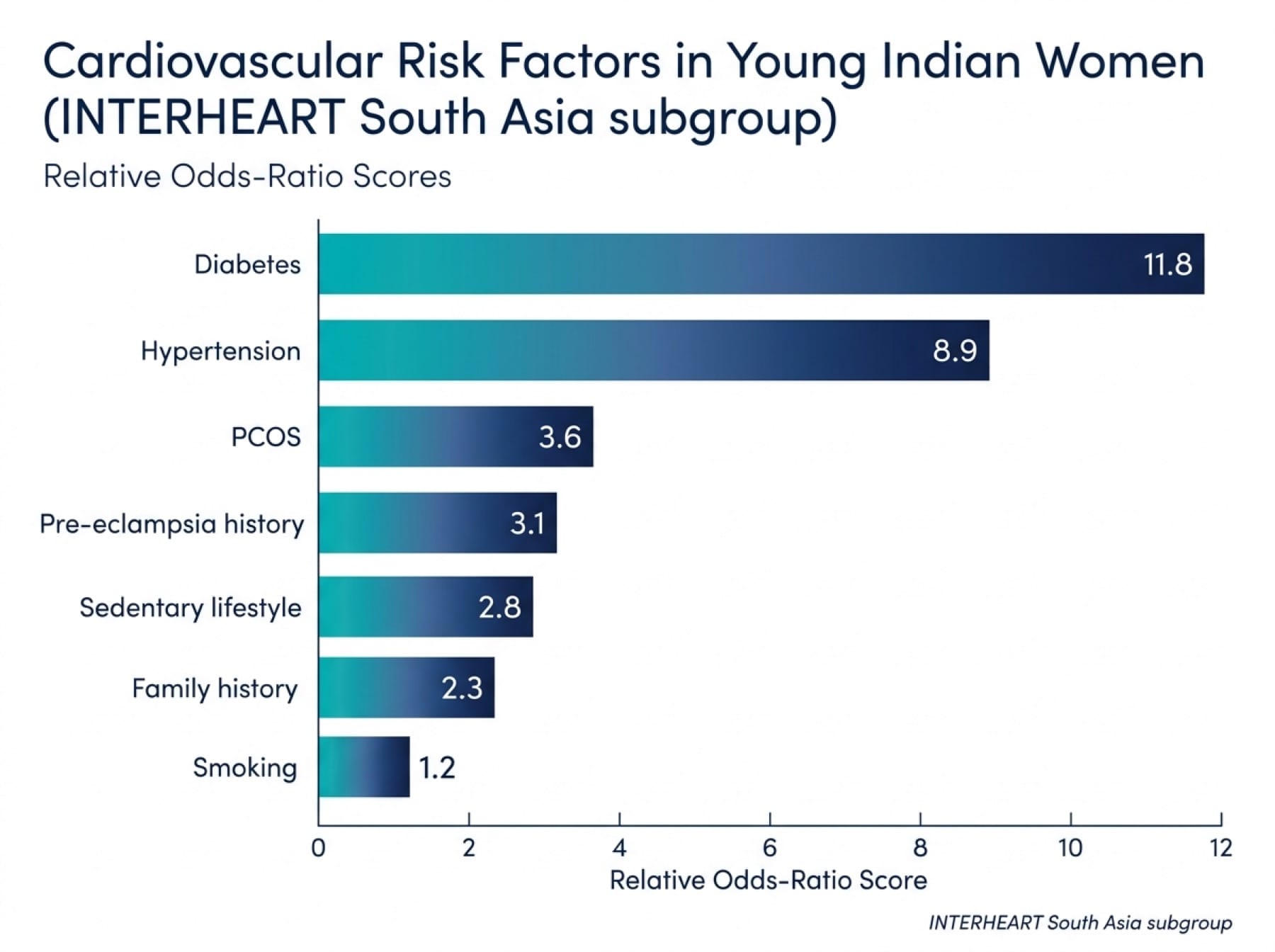
Bar chart ranking top cardiovascular risk factors for Indian women from INTERHEART data
The specific tests that matter include a fasting lipid profile (to assess LDL, HDL, and triglycerides), fasting blood glucose and HbA1c (a blood test showing your average blood sugar over the previous three months, used to assess glycaemic control), blood pressure measurement, and body mass index with waist circumference. These are not complex investigations. They are routinely available at most Indian private clinics and are recommended annually for women with the risk profile above. For more on which tests Indian adults should include in their annual health evaluation, see our guide to annual health tests.
Emergency symptoms that warrant calling 112 immediately include chest pain or pressure, sudden severe shortness of breath, sudden unusual fatigue, unexplained nausea or cold sweats, or pain in the jaw, back, or left arm. This applies even if the symptoms seem mild or ambiguous. In women, mild or atypical symptoms may represent a heart attack in progress. The cost of an unnecessary emergency department visit is negligible compared to the cost of a delayed diagnosis.
The Bottom Line
The belief that heart disease is primarily a man's problem is not only incorrect for Indian women, it is becoming increasingly dangerous as the data diverges further from that assumption. Indian women's ischaemic heart disease mortality is rising faster than men's. The INTERHEART study established that hypertension and diabetes are more damaging to younger Indian women than to men of the same age. The thin-fat South Asian phenotype, PCOS, pregnancy complications, and the relentless psychosocial burden of dual labour roles are all loading cardiovascular risk onto a generation of Indian women whose doctors may not be looking for it.
The solution is not complex: awareness that heart disease is a woman's disease too, a risk factor evaluation at younger ages than currently standard, recognition that atypical symptoms require the same urgency as classic chest pain, and primary prevention through the modifiable risk factors that the INTERHEART study established as responsible for 90% of the risk (lipid control, blood pressure management, physical activity, diet, and smoking cessation).
Coronary artery disease is now the leading cause of death in Indian women. It should be treated as such.
Action This Week
Pick one. If you are over 30, book a basic cardiac risk check (fasting lipid profile, fasting blood glucose or HbA1c, blood pressure, waist circumference). If you have a history of PCOS, pre-eclampsia, gestational diabetes, or early family heart disease, tell your doctor explicitly and ask for a cardiac risk evaluation. Save 112 in your phone and learn the atypical heart attack symptoms (fatigue, nausea, back/jaw pain, shortness of breath without chest pain).
Stay informed on women's health and preventive care in India
SwasthiQ covers India-specific clinical evidence on women's health, cardiovascular risk, and preventive care for patients and clinic owners. Subscribe to our monthly newsletter: evidence-based, no wellness-industry hype.
Think Care · Think SwasthiQ
Related reading: PCOS in India: prevalence, risks, and what the evidence shows | Magnesium deficiency: the silent nutritional gap in Indian diets | Important annual medical tests every adult in India should know