Fat Burner Side Effects in India: What Is Actually in Those Supplements
India's weight loss supplement market is worth approximately USD 1.4 billion in 2024, growing at 18%+ annually, with social media driving most purchases. DNP has caused documented deaths globally, DMAA was linked to fatal cardiac arrests, and supplement-related liver transplant waitlistings increase
Note: This article is for informational purposes only. If you have taken a supplement and experienced symptoms including rapid heartbeat, severe nausea, high body temperature, or jaundice, seek emergency medical care immediately. Do not purchase weight loss supplements from unverified sources or without verifying FSSAI compliance.
Fat burner side effects in India are no longer a fringe concern. India's weight loss supplement market was valued at approximately USD 1.4 billion (roughly Rs. 11,700 crore) in 2024. It is growing at a compound annual growth rate of over 18%, according to Grand View Research data published in April 2026. Pills and capsules are the fastest-growing format segment. Social media influences more than half of purchasing decisions among adults aged 19 to 40, according to Indian consumer-marketing research cited by Grand View Research and the Observer Research Foundation in their April 2026 reports on the supplement category. The accelerant is a well-documented demographic reality. The proportion of overweight or obese Indians, including those classified as overweight under WHO's Asian BMI thresholds (BMI 23 to 24.9), rose from 25% in 2013 to nearly 40% in 2023, according to ICMR-NIN data cited by the Observer Research Foundation in August 2025, and millions of people are looking for ways to accelerate weight loss beyond diet and exercise.
The problem is that the market is largely unregulated in practice, despite formal regulation existing on paper. The ingredients that make some of these products genuinely dangerous (among them industrial chemicals originally designed for munitions and pharmaceutical drugs recalled globally for cardiovascular deaths) are circulating in India through import channels, online marketplaces, and gym counters that regulatory enforcement has not caught up with.
India's fat burner supplement market is growing at over 18% annually on the back of social media marketing, but the ingredients most commonly responsible for deaths and organ damage are either explicitly banned, absent from FSSAI's positive permitted list, or present in grey-market imports that the current self-certification model cannot systematically screen. This guide covers what those ingredients are, what the peer-reviewed evidence says about their consequences, and what to check before buying anything marketed as a fat burner in India.
SwasthiQ is building Healthcare Rails for India, the connected ecosystem that links supplement adverse events, lab results, and clinical records so a liver injury from a fat burner is something a doctor can recognise and report, not an isolated emergency. Supplement safety is a connected-health problem, not just a regulatory one.
Official sources: PMC8131886 (DNP toxicity, 2021) | PMC4607104 (DNP in supplements, 2015) | PMID 34331346, Ghabril et al. Liver Transplant 2022 | PMC12826854, Military Medicine 2025 | FSSAI FSS Nutraceuticals Regulations 2016
What Fat Burners Claim vs What the Evidence Shows
The phrase "fat burner" is a marketing category, not a clinical one. Under FSSAI's regulatory framework, products marketed for weight management are classified as food for special dietary use or health supplements and are governed by the Food Safety and Standards (Health Supplements, Nutraceuticals, Food for Special Dietary Use, Food for Special Medical Purpose, and Prebiotic and Probiotic Food) Regulations 2016. These regulations require that all ingredients in weight management supplements appear on FSSAI's positive permitted list and remain within ICMR-NIN recommended daily allowance limits. If a manufacturer uses an ingredient not on the list, or at doses above the permitted level, specific scientific justification must be submitted to and approved by FSSAI.
In practice, the marketed claims of fat burners fall into several categories: thermogenics (products that claim to increase the body's heat production and metabolic rate), appetite suppressants (products claiming to reduce hunger), lipase inhibitors (products that claim to block fat absorption by inhibiting the lipase enzyme, which is the digestive enzyme that breaks dietary fat into smaller molecules the gut can absorb), and stimulant blends (products containing caffeine and other compounds that increase energy expenditure). The evidence supporting most of these claims in over-the-counter supplement form is weak. A widely cited review published in Obesity Reviews by Jeukendrup and Randell (2011, PMID: 21951331, DOI: 10.1111/j.1467-789X.2011.00908.x) concluded that the evidence base for most commercially available fat-burner ingredients is weak, and that even the best-supported compounds produced modest and often short-term metabolic effects that fall significantly below what the marketing claims for these products suggest. The review covered the full range of commonly marketed thermogenic ingredients including caffeine, carnitine, green tea, and conjugated linoleic acid.
The actual danger is not that the products fail to work. It is that some of the compounds responsible for any effect they do produce are also responsible for a range of serious adverse events, from liver failure to cardiac arrest to death. The compounds most responsible for the worst outcomes are precisely those that FSSAI's permitted ingredient lists do not include.
Fat Burner Side Effects in India, Part 1: DNP, the Industrial Chemical Sold as a Supplement
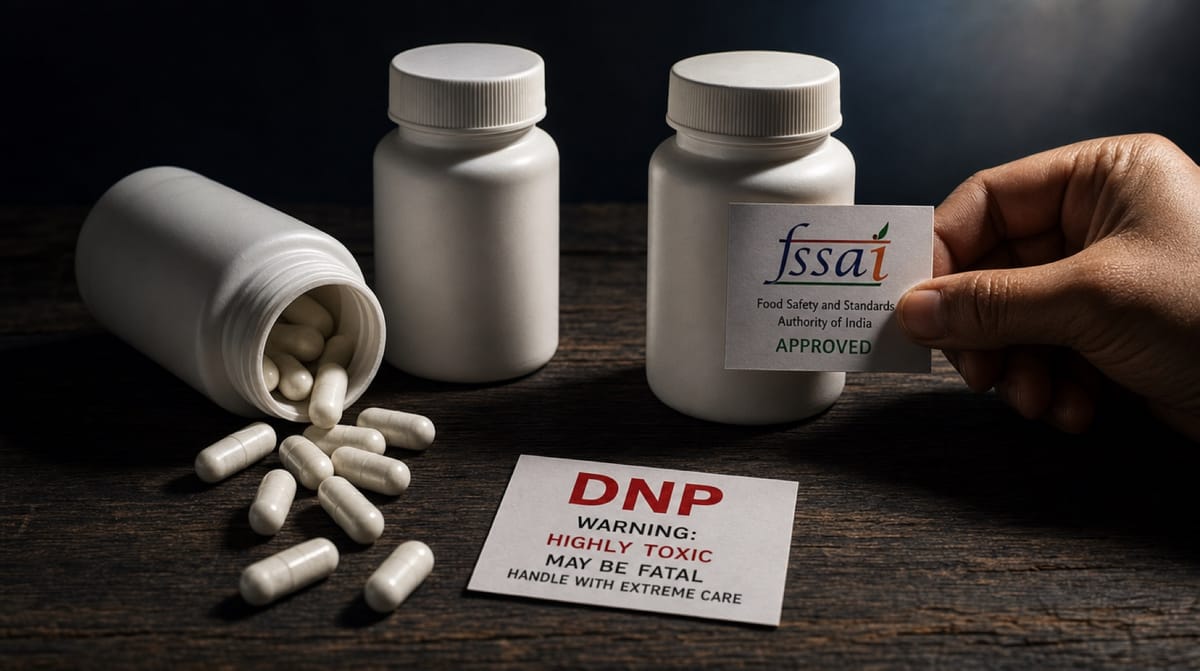
The most dangerous substance found in weight loss supplements globally is 2,4-dinitrophenol (DNP), an industrial chemical originally developed for use in dyes, wood preservatives, herbicides, and explosives. Its history as a weight-loss agent dates to the 1930s, when it was found to increase metabolic rate by uncoupling mitochondrial respiration (disrupting the process by which cells produce energy from nutrients, causing that energy to be released as heat instead). It was withdrawn from clinical use in the same decade because of its side effects, which include severe hyperthermia (dangerous elevation of body temperature), cataracts, agranulocytosis (destruction of white blood cells), and death.
A peer-reviewed case study and review published in BMJ Open (PMC8131886, 2021) confirmed that the UK National Poisons Information Service recorded a sharp rise in enquiries relating to DNP toxicity and stated plainly that DNP has no safe dose and is highly toxic. The paper documented that DNP was being sold online as a weight-loss supplement and bodybuilding aid, particularly through internet forums and grey-market supplement sites. A separate study published in Substance Abuse Treatment, Prevention and Policy (PMC4607104) purchased and chemically analysed 98 pre-workout and weight-loss supplements to test for DNP contamination. The authors described DNP as being sold both as a standalone product and as an adulterant added to legitimate-appearing supplements.
Multiple human fatalities from DNP are documented in peer-reviewed literature and government toxicology databases. The ATSDR (Agency for Toxic Substances and Disease Registry) Toxicological Profile for Dinitrophenols (NBK590059, NCBI Bookshelf) records multiple autopsy-confirmed deaths from both acute and intermediate-duration oral DNP exposure, including cases where doses as low as 1 to 5 mg/kg/day over 41 to 46 days resulted in death. The FDA declared DNP "extremely dangerous and not fit for human consumption" as early as 1938. The mechanism of harm is physiologically direct. DNP forces cells to burn fuel as heat without making usable energy. Core body temperature rises to levels that damage proteins, trigger multi-organ failure, and cause death. The dose-response curve is extremely steep, there is no antidote, and intensive care interventions frequently cannot prevent death once severe toxicity develops.
DNP is not on FSSAI's positive ingredient list for health supplements. Its presence in any product sold in India as a supplement or food product is a violation of the FSS Act 2006.
Fat Burner Side Effects in India, Part 2: DMAA, Ephedra, and the Stimulant Category
DMAA (1,3-dimethylamylamine), an amphetamine-like stimulant originally developed as a nasal decongestant, became a widespread ingredient in sports and weight-loss supplements under marketing names including geranium extract, geranamine, and methylhexanamine. The US FDA moved to ban DMAA after documenting multiple deaths and serious adverse events. A peer-reviewed case series published in Military Medicine by Eliason et al. (2012, PMID: 23397688) documented two active-duty US soldiers who collapsed during physical exertion from cardiac arrest and died after taking DMAA-containing dietary supplements. A separate case report by Karnatovskaia et al. in the Clinical Journal of Sports Medicine (2015) documented cardiac arrest in a 21-year-old man following ingestion of a DMAA-containing workout supplement. Haemorrhagic stroke (bleeding inside the brain) was additionally reported by Young et al. (2012) in association with DMAA.
DMAA is not on FSSAI's permitted ingredient list. Any supplement sold in India containing DMAA is non-compliant under the FSS (Health Supplements, Nutraceuticals) Regulations 2016.
Ephedra (Ma Huang, a plant source of ephedrine alkaloids, which are stimulants that raise heart rate and blood pressure), was one of the most widely used thermogenic fat-burner ingredients through the 1990s and early 2000s. The US FDA banned ephedra-containing dietary supplements in 2004 after more than 800 reports of serious toxicity and 22 deaths directly linked to ephedrine alkaloids. The toxicological profile includes cardiac arrhythmia (an abnormal heart rhythm), hypertensive crisis (a dangerous spike in blood pressure), stroke, and sudden cardiac death, particularly when combined with caffeine, which was and remains a standard co-ingredient in thermogenic supplements. In India, ephedrine is a controlled substance under the Narcotic Drugs and Psychotropic Substances Act 1985 and is not a permitted ingredient in food supplements.
The ephedra pattern illustrates a structural problem with the fat burner market. Banned ingredients do not disappear. They are replaced with structurally similar compounds that have not yet been evaluated for safety, and the cycle repeats. DMAA replaced ephedra in many formulations. When DMAA was banned, manufacturers moved to DMHA, octodrine, and other synthetic compounds with similar mechanisms and substantially less safety data.
Sibutramine: The Banned Drug Still in the Market
Sibutramine was a prescription drug for obesity that was voluntarily withdrawn from global markets in 2010 after a clinical trial (SCOUT, NEJM 2010) found it increased the risk of heart attack and stroke in patients with pre-existing cardiovascular disease. In India, the Central Drugs Standard Control Organisation (CDSCO) has banned sibutramine as a pharmaceutical drug.
The persistence problem is that sibutramine has been repeatedly found as an undeclared ingredient in supplements marketed as "herbal" or "natural" weight-loss products, primarily those manufactured or sourced from China and sold through online channels. The compound produces genuine appetite suppression, giving users results they attribute to the "herbal" formula, while concealing a drug that is banned precisely because of its cardiovascular risk. Consumers with undiagnosed hypertension or coronary artery disease face serious risk from undeclared sibutramine exposure at doses and without the clinical monitoring that its prescription history required.
The CDSCO has issued warnings and advisories regarding undeclared sibutramine in imported supplements. The challenge is that consumer-facing products are not routinely laboratory-tested before they reach shelves, and self-certification by manufacturers provides no protection against deliberate adulteration.
The Liver Damage Evidence: Peer-Reviewed Data
The liver injury evidence for weight-loss supplements, including fat burners, is now substantial enough to have entered mainstream hepatology. A study by Ghabril et al. published in Liver Transplant in 2022 (PMID: 34331346, DOI: 10.1002/lt.26246) found an 8-fold increase in dietary supplement-related liver failure leading to transplant waitlisting over the previous 25 years in the United States. The study analysed data from multiple liver transplant centres and identified supplements, including fat burners and bodybuilding products, as a growing contributor to end-stage liver disease requiring transplant.
A 2025 case study published in Military Medicine (PMC12826854, May 2025) documented severe cholestatic liver injury (a form of liver failure in which bile flow is blocked, causing bilirubin levels to rise dangerously) in a patient who took a commercially available fat burner called AlbutarexV2. The authors noted the product's total bilirubin reached 41.66 mg/dL (a normal value is below 1 mg/dL) and that recovery took over six months. The paper explicitly states that recognition of adverse effects from these therapies is critical to aid in identification and cessation of the agent and helping ban harmful supplements.
High-dose green tea extract is one of the most widely marketed fat-burner ingredients in India, appearing in capsule, powder, and beverage products with a "natural" health halo. The active compound, EGCG (epigallocatechin gallate, the primary catechin in green tea responsible for its antioxidant effects), has documented hepatotoxic potential at supplemental doses substantially higher than what you would get from drinking tea. Several peer-reviewed case reports and the National Institutes of Health LiverTox database document acute liver failure, including cases requiring transplant evaluation, from green tea extract supplements. The NIH LiverTox entry for green tea (NBK547922) specifically identifies green tea extract as a confirmed cause of drug-induced liver injury, with hepatocellular and mixed patterns of injury (damage primarily to liver cells, with or without bile-flow disruption) documented in the medical literature. The dose matters critically. Green tea as a beverage is safe. Concentrated extracts at supplement doses are not equivalent. FSSAI's RDA limits for specific botanical extracts, including green tea, are precisely designed to address this dose distinction, but grey-market and imported products routinely exceed these thresholds.
Caffeine in thermogenic supplements deserves specific mention. Fat burners routinely contain 200 to 400 milligrams of caffeine per serving, equivalent to two to four strong cups of coffee. Combined with pre-workout drinks, energy drinks, or other caffeine sources (as they frequently are by the gym-going consumer population that is the primary target market), total daily caffeine intake can reach dangerous levels. Cardiac arrhythmia, seizures, and in extreme cases death have been documented from caffeine toxicity. A case report indexed on PubMed (Jabbar and Hanly, PMID: 24196726) documented a fatal caffeine overdose in a 39-year-old man who self-administered approximately 12 grams of pure caffeine anhydrous purchased as a dietary supplement; autopsy blood caffeine levels were 350 mg/L, consistent with severe toxicity. A separate peer-reviewed case (Yamamoto et al., J Toxicol Pathol, 2015, PMC4337497) reported caffeine intoxication death attributable to supplement use.
India's Regulatory Framework: What Exists and Where the Gaps Are
FSSAI's framework for weight loss supplements has three key features. First, only ingredients on FSSAI's positive list (the Schedules under the Nutraceuticals Regulations) are permitted. Second, those ingredients must be within ICMR-NIN recommended daily allowance limits or must have specific FSSAI scientific approval. Third, health claims made on packaging and in advertising must be substantiated and must not be misleading, under the FSS Advertising and Claims Second Amendment Regulations 2022.
Where the framework has gaps is in enforcement architecture. Manufacturers self-certify compliance. The test results they submit to FSSAI are generated by their own commissioned laboratories, are not made publicly available, and are not independently audited batch by batch. FSSAI's 2023 special enforcement drive against non-compliant nutraceuticals (reported by NutraIngredients in March 2023) acknowledged that non-compliance has been a parliamentary-level concern. A 2024 government task force specifically pressured online platforms including Amazon and Flipkart to remove unapproved supplement products. FSSAI does not automatically accept ingredient approvals from FDA, EFSA, or other foreign regulators. A supplement that is legal in the US is not automatically legal in India, and many imported fat burner products circulating in the Indian market are non-compliant.
Critically, FSSAI's regulatory framework was not built to catch grey-market imports. It cannot screen them systematically. Products sold through personal import channels, brought in as luggage, sold peer-to-peer on platforms like Instagram and Telegram, or sold through websites hosted outside India operate entirely outside any regulatory framework. These channels carry the highest risk products, including DNP, sibutramine-adulterated "herbal" formulas, and DMAA-containing pre-workouts.
The Social Media and Influencer Problem
The fat burner market's growth in India is driven substantially by influencer marketing. A fitness influencer with a large following promotes a supplement, typically showing before-and-after photographs or endorsing results that are not reliably attributable to the supplement rather than their concurrent diet and exercise. The FSSAI Advertising and Claims regulations prohibit misleading claims, but enforcing these regulations against social media content created by individual influencers or small accounts is not the same as enforcing them against packaged labels on retail shelves.
The consumer who decides to buy a fat burner based on an Instagram recommendation may not know that the product shown is not FSSAI-registered, that its ingredients have not been evaluated against the permitted list, or that the "results" shown involve unrelated lifestyle changes. The same platforms that pressure Indian retailers to carry FSSAI-compliant products do not apply equivalent scrutiny to the marketing content driving purchases.
The Advertising Standards Council of India (ASCI) issued guidelines in 2021 requiring influencers to disclose paid promotions. These guidelines do not address the accuracy of the health claims made, which remains FSSAI's jurisdiction. The jurisdictional gap between advertising regulation (ASCI), food safety regulation (FSSAI), and drug regulation (CDSCO) creates a space in which dangerous products move through social media to consumers faster than any single regulator can respond.
How to Identify Red Flags on a Fat Burner Label
The following are specific, actionable indicators that a weight loss supplement may be non-compliant, adulterated, or dangerous.
No FSSAI licence number visible on the packaging. FSSAI registration is mandatory for all food and supplement products legally sold in India. Its absence is a definitive red flag. Verify any licence number at fssai.gov.in. A fake number is also possible, which is why purchasing from verified retail channels matters.
Ingredients listed with obscure or trademarked names rather than chemical names. DNP is sold under names including Sulfo Black, Caswell No. 392, and Nitro Kleenup. DMAA appears as geranium extract, geranamine, 1,3-DMAA, and methylhexanamine. If the ingredient list contains unfamiliar terms, searching the chemical name specifically (not the product name) is the correct approach.
"Proprietary blend" with total dose but no per-ingredient breakdown. This framing allows manufacturers to include ingredients at doses above what would be permitted if disclosed individually, while presenting a legally defensible label. FSSAI regulations require individual ingredient disclosure. A proprietary blend label may indicate import from a jurisdiction with weaker disclosure requirements.
Extreme dosing claims or very rapid result timelines. "Lose 10 kg in 30 days" is a marketing claim with no biological plausibility at safe supplement doses. If results claimed are achievable only with a pharmacologically active substance, the product may contain one.
Products sold exclusively through Instagram, Telegram, or peer networks. Any fat burner not available through a mainstream licensed Indian retailer or pharmacy, and not displaying an FSSAI number, should be treated as an unknown risk product. For guidance on reading supplement and food labels more broadly, see our guide to label literacy in India.
The Bottom Line
The Indian fat burner supplement market is large, growing rapidly, and operating in a regulatory environment where the gap between formal rules and actual enforcement gives non-compliant products substantial room to circulate. The peer-reviewed evidence on the worst-case outcomes (DNP deaths, DMAA cardiac arrests, sibutramine-driven cardiovascular events, and the 8-fold rise in supplement-related liver transplant waitlistings) is not hypothetical or historical. These events continue to occur in markets similar to India's, and the ingredients responsible for them are accessible in India through import and grey-market channels.
FSSAI's positive ingredient list and the Nutraceuticals Regulations 2016 provide the legal framework for a safe supplement market. The gap is in pre-market testing, public test result disclosure, and enforcement reach into the digital and grey-market channels that carry the highest-risk products. Until those gaps close, the responsibility for consumer safety sits substantially with the consumer. The rule is simple: if a product is not FSSAI-licensed, comes from an unverifiable source, contains unfamiliar ingredient names, or promises results that require pharmacological action to deliver, it should not be purchased. The consequences of getting that judgment wrong are not reversible.
Action This Week
Pick one. Open any fat burner or weight-loss supplement you currently own and verify its FSSAI licence number at fssai.gov.in. Search every ingredient on the label specifically for the chemical name (not the trademarked name) to check whether it appears on FSSAI's positive list. If you experience any symptoms after taking a supplement (rapid heartbeat, severe nausea, fever, jaundice, yellow eyes), stop immediately and seek emergency medical care.
Stay informed on supplement safety and food regulation in India
SwasthiQ covers FSSAI regulatory updates, supplement safety evidence, and India-specific consumer health guidance. Subscribe to our monthly newsletter: evidence-based, no wellness-industry hype.
Think Care · Think SwasthiQ
Related reading: How to read food labels in India: FSSAI decoded | Natural vs chemical: busting the health myths that won't die | Important annual health tests every adult in India should know