Sleep Disorders in India: The Most Underrated Public Health Crisis
A 2025 meta-analysis of 100 Indian studies found insomnia in 15% of the general population, OSA in nearly 15%, and significant links to diabetes and heart disease. India has no national sleep policy.
Note: This article is for informational purposes only. If you suspect you or a family member has obstructive sleep apnoea, insomnia disorder, or another sleep condition, consult a doctor or sleep specialist. Do not use sleeping pills without medical supervision.
India tracks diabetes. It tracks hypertension. It tracks cancer. It has national programmes for tuberculosis, maternal health, and malaria. What it does not have is a national sleep health programme, a recognised postgraduate sleep medicine specialty in most medical universities, or a sustained public health campaign on the consequences of inadequate or disordered sleep for its population's health.
A systematic review and meta-analysis published in the Indian Journal of Public Health in October 2025 by Datta, Bhutambare, and Mallick of AFMC Pune, covering 100 eligible studies encompassing 67,844 individuals and following PRISMA 2021 guidelines, found insomnia in approximately 15% of the general Indian population, obstructive sleep apnoea (OSA) in nearly 15% of the same group, and restless leg syndrome (RLS) in over 10%. When patient populations with comorbidities such as diabetes and heart disease were included, the figures were substantially higher. The paper was titled, with some precision, a "Wake-up Call for India on Sleep Health."
A 2025 systematic review of 100 Indian studies found insomnia affecting 15% of the general Indian population, OSA affecting nearly the same proportion, and significant bidirectional links between sleep disorders and India's NCD burden. India has no national sleep health programme, and the connections between chronic sleep deprivation and the conditions already killing the most Indians are not reflected in any public health campaign currently running in the country. This is what the evidence shows and why it matters.
SwasthiQ is building Healthcare Rails for India, the connected ecosystem that links a patient's sleep history, lab results, and clinical record so that a sleep disorder flagged in a general physician's visit can be followed through cardiology, endocrinology, and mental health rather than being lost between specialties. Sleep is not a peripheral health variable; it belongs in a connected health record.
Official sources: Datta et al., Indian J Public Health, 2025, PMID 40964736 | National Medical Journal of India, 2018, Sleep Policy | Indian Journal of Sleep Medicine 2025 | LocalCircles India Sleep Survey 2026
What the 2025 Meta-Analysis Actually Found
The Datta et al. study (PMID 40964736, DOI: 10.4103/ijph.ijph_504_24) is the most comprehensive systematic review of sleep disorder prevalence in India published to date. Its meta-analytic approach covered 100 eligible studies drawn from PubMed, Google Scholar, PsycNet, and Epistemonikos, assessed using the ten-point Joanna Briggs Institute (JBI) checklist for prevalence studies (a standardised quality-assessment tool for prevalence research) and registered with PROSPERO (the international prospective register of systematic reviews, where review protocols are publicly logged before analysis begins to prevent post-hoc cherry-picking), entry number CRD42022368993. This is a mark of methodological rigour.
The pooled estimates across all populations (combining both clinical patients and the general population) were 25.7% for insomnia (95% confidence interval: 16.3% to 38.0%), 37.4% for obstructive sleep apnoea (95% CI: 27.8% to 48.2%), and 10.6% for restless leg syndrome (95% CI: 7.0% to 15.9%). These figures carry very high heterogeneity (I² exceeding 97% for all three conditions; I² is a statistical measure of how much the included studies disagree with each other, where above 75% indicates substantial inconsistency), which the authors acknowledge and which is expected given that included studies ranged from clinical outpatient populations with high comorbidity to college students to community-based general population samples. Pooled estimates across such heterogeneous populations are informative about the overall burden but should not be taken as a single prevalence for the Indian population at large.
When the authors conducted subgroup analysis separating general population studies from patient population studies, the general population estimates were more conservative and more directly applicable to a public health context. Insomnia prevalence in the general Indian population was 15.1% (95% CI: 8.0% to 26.6%) and OSA prevalence was 14.6% (95% CI: 9.2% to 22.5%). Even these more conservative figures represent a substantial burden. The study's conclusion is unambiguous: "Increased prevalence of sleep problems existed in noncommunicable diseases and the general population. A need to recognise the allostatic load of sleep problems in noncommunicable diseases is highlighted." Allostatic load is the cumulative wear-and-tear on the body from chronic stress and disrupted biological rhythms.
How Much Sleep Do Adults Actually Need?
The National Sleep Foundation (NSF) and the American Academy of Sleep Medicine (AASM) both recommend seven to nine hours of sleep per night for adults, a guideline cited in the Indian Journal of Sleep Medicine in 2025. This recommendation is based on decades of evidence correlating sleep duration with health outcomes including cardiovascular function, metabolic regulation, immune competence, cognitive performance, and injury risk. The science does not support the idea that adaptation to less sleep is possible over the long term. The subjective sense of being used to sleeping five hours a night does not correspond to restored physiological function.
India's population-level sleep data is complicated. The Government of India Time Use Survey 2019, which collected data from 330,207 adult members of households, found an average sleep duration of 8 hours and 19 minutes across Indian adults, which appears adequate by NSF standards. However, this figure masks significant variation. 3.8% of Indian adults reported short sleep duration (at or below six hours) and 33.7% reported long sleep duration (nine hours or more). Urban, highly educated, and higher-income individuals reported shorter sleep durations in this data, reflecting the pattern most associated with professional work demands, screen use, and irregular schedules.
A more recent assessment by LocalCircles, which conducted a nationwide survey between December 2025 and March 2026, found that 46% of Indian respondents reported getting less than six hours of uninterrupted sleep daily. While online surveys carry selection bias and this figure should be interpreted as directional rather than population-representative, the trend it captures is consistent with what clinical practice in urban India documents: chronic curtailment of sleep, particularly among working-age adults in metropolitan areas.
The Three Main Sleep Disorders: What They Are and Why They Matter in India
Insomnia is defined by persistent difficulty initiating sleep, maintaining sleep, or experiencing non-restorative sleep at least three times per week for at least three months, despite adequate opportunity for sleep, resulting in daytime impairment. It is the most studied sleep disorder and the one most associated with India's urban professional population, given its close bidirectional links with anxiety and depression. Datta et al. found general population insomnia prevalence at 15.1% in India, rising to 32.3% in clinical populations. Women have a higher prevalence of insomnia than men across most published studies, a pattern consistent with global data.
Insomnia is not simply difficulty sleeping. Chronic insomnia increases the risk of depression, anxiety, hypertension, cardiovascular disease, and diabetes (conditions that are already endemic in India). The relationship is bidirectional. Each of these conditions also disrupts sleep, creating a reinforcing cycle. India's NFHS-5 prevalence of hypertension (28.5% of adults aged 18 to 69) and ICMR-INDIAB's documentation of 101 million people with diabetes make insomnia not a peripheral concern but a central driver and consequence of India's two most prevalent chronic conditions.
Obstructive sleep apnoea (OSA) is a sleep-related breathing disorder in which the upper airway repeatedly collapses during sleep, causing oxygen desaturation and fragmented sleep. The affected person typically does not know they have OSA. Their bed partner may report loud snoring and episodes of breathing cessation. Daytime consequences include excessive sleepiness, difficulty concentrating, morning headaches, and impaired reaction time. OSA is significantly associated with hypertension, cardiac arrhythmia, heart failure, and stroke in the established literature.
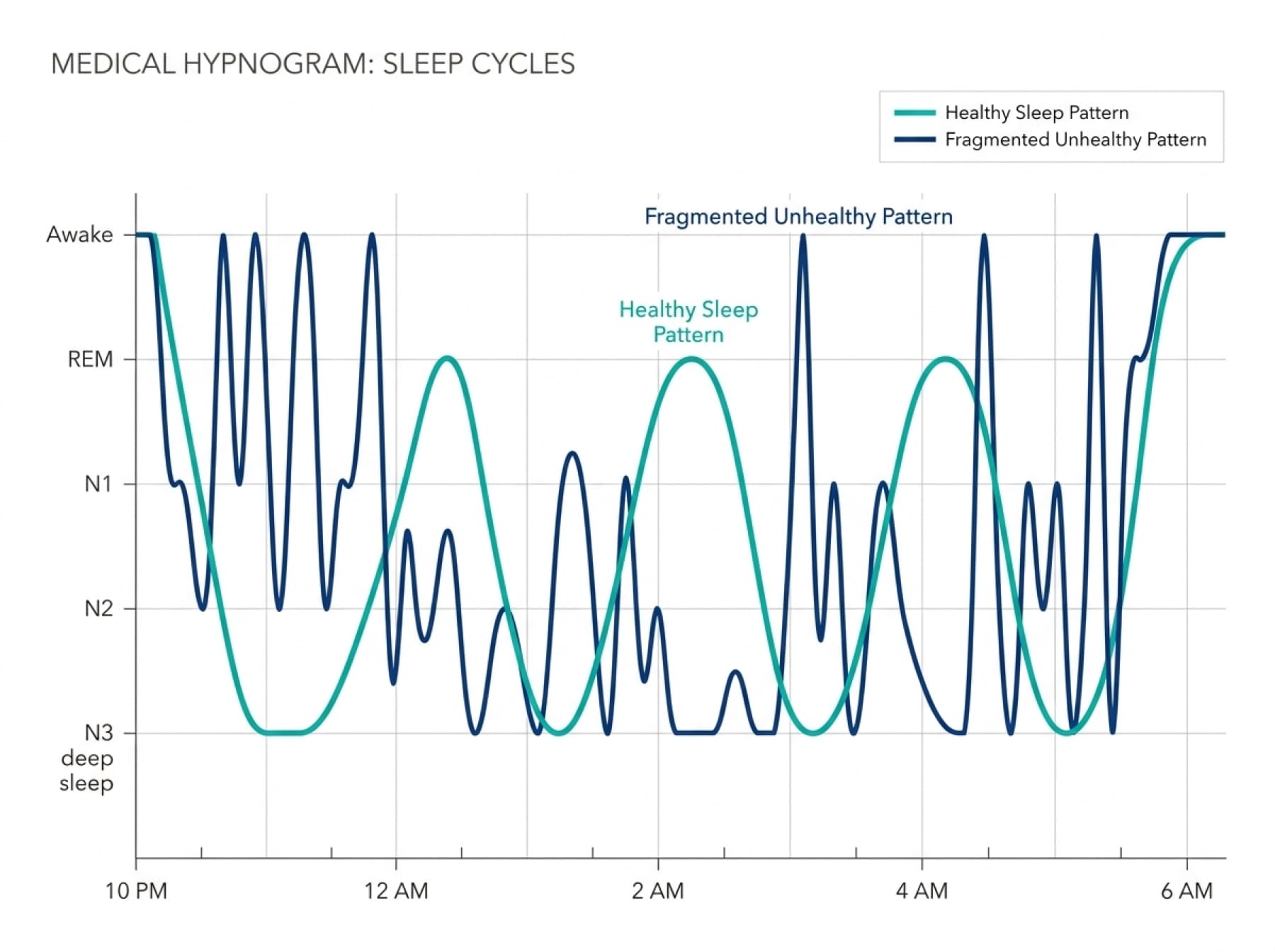
Hypnogram comparing a healthy overnight sleep cycle to a fragmented, apnoea disrupted pattern.
In India, the general population OSA prevalence from Datta et al. was 14.6%. Suri et al. (Sleep Medicine, 2023), a separate systematic review and meta-analysis of OSA in India examining general adult population data using polysomnography-defined thresholds, estimated an overall prevalence of 11%, with approximately 104 million Indians of working age meeting the diagnostic threshold, of whom an estimated 47 million had moderate-to-severe OSA. These numbers place India's OSA burden among the largest globally, yet awareness of the condition among the general public and even among non-specialist clinicians in India remains low, and CPAP therapy (the standard treatment) is substantially underutilised.
Restless leg syndrome (RLS) is characterised by an irresistible urge to move the legs, typically in the evening and at rest, often with unpleasant sensations described as crawling, pulling, or aching. It is poorly recognised in India. Datta et al. found a pooled RLS prevalence of 10.6% in India. RLS severely disrupts sleep onset and maintenance. It is associated with iron deficiency, a condition affecting a significant proportion of Indian women, which is clinically important because iron supplementation can resolve secondary RLS entirely. Many Indian adults with RLS have never received a diagnosis, and many who are diagnosed are told they have "leg pain" or "circulation problems" rather than receiving evidence-based treatment.
Sleep, NCDs, and Immunity: The Links India's Public Health System Ignores
The Datta et al. meta-analysis found that sleep disorder prevalence was specifically elevated in patients with diabetes and heart disease, a finding consistent with a large and established global body of evidence. The relationship between sleep and the body's major systems is not incidental.
Sleep and cardiovascular disease. Both insufficient sleep (defined as less than six hours per night) and excessive sleep (more than nine hours per night) are associated with elevated cardiovascular risk in prospective studies. The mechanisms include dysregulation of autonomic nervous system tone (the body's automatic control of heart rate, blood pressure, and digestion), increased sympathetic activity (the fight-or-flight branch of the nervous system) during fragmented sleep, and inflammatory pathway activation. For Indian adults who already carry elevated cardiovascular risk (due to the South Asian phenotype, high rates of hypertension and diabetes, and sedentary urban lifestyles), inadequate sleep is not a lifestyle choice that affects only energy levels. It is a cardiovascular risk factor.
Sleep and type 2 diabetes. Sleep deprivation impairs insulin sensitivity and glucose metabolism through multiple mechanisms, including increased cortisol secretion (which raises blood glucose), altered secretion of appetite-regulating hormones ghrelin and leptin (ghrelin signals hunger and rises with sleep loss, leptin signals fullness and falls with sleep loss, the net effect being increased caloric intake), and reduced activity of cells involved in glucose disposal. Even a single night of inadequate sleep produces measurable glucose intolerance in healthy individuals. For the 136 million Indians with pre-diabetes, chronic sleep deprivation is accelerating the progression of a condition that could otherwise be managed or reversed through lifestyle intervention.
Sleep and immune function. Sleep is not merely restful. It is biologically active. During slow-wave sleep, the body performs immune consolidation including production and release of cytokines (chemical messengers immune cells use to coordinate responses to infection), T-cell regulation, and natural killer (NK) cell activity (NK cells are a class of white blood cells that destroy virus-infected and cancerous cells). Chronic sleep restriction reduces NK cell activity and impairs the antibody response to vaccination, effects documented in peer-reviewed immunology literature including a 2019 review by Irwin MR in Annals of the New York Academy of Sciences (DOI: 10.1111/nyas.13602). A population with poor average sleep quality is a population with a weakened collective immune response. This is relevant in India's context of ongoing infectious disease burden (TB, respiratory infections, and post-pandemic immune debt) alongside its NCD burden.
Sleep and mental health. The bidirectional relationship between sleep and mental health is among the most robustly documented in clinical psychiatry. Insomnia is both a symptom of depression and anxiety and a causative or maintaining factor. India's mental health burden, substantially under-recorded and under-treated, is compounded by poor sleep in the working-age population. Addressing sleep is not a luxury consideration for mental health care in India. It is a first-line clinical component.
Why India Sleeps Poorly: The Specific Drivers
India's sleep problem is not simply a consequence of individual choices. Structural factors specific to India's socioeconomic and cultural context drive poor sleep at the population level.
The growth of India's IT, BPO, and service industries has created a very large shift-work workforce, particularly in cities including Bengaluru, Hyderabad, Pune, Noida, and Chennai. Shift work, particularly night shifts and rotating schedules, causes circadian rhythm disruption, the misalignment of the internal biological clock (a roughly 24-hour cycle in the brain that times sleep, hormone release, body temperature, and digestion) with the external light-dark cycle. Circadian misalignment (when behaviour and the body clock are out of phase, as happens with shift work or jet lag) is independently associated with metabolic syndrome, obesity, and cardiovascular disease, even when total sleep hours are adequate.
Smartphone and screen use in India has created an epidemic of blue-light-mediated suppression of melatonin (the hormone that tells the body it is time to sleep), particularly among adolescents and young adults. Blue light from screens at night delays melatonin onset, pushes sleep onset later, reduces total sleep time when wake time is fixed by school or work schedules, and reduces slow-wave sleep duration. India's adolescent sleep problem, documented in studies including an AFMC study finding 39% of children aged 10 to 18 had sleep disruption, flows directly into the adult sleep problem.
Thermal stress is an under-discussed determinant of sleep quality in India. Sleep initiation and maintenance are dependent on a drop in core body temperature of approximately 0.5 to 1 degree Celsius. In India's northern plains, southern peninsular heat, and in inadequately ventilated urban housing, ambient temperatures during summer months frequently prevent this thermoregulatory drop. This is not a health problem unique to India, but it is a structurally underinvested one.
Psychosocial stress (from occupational pressures, financial insecurity, care responsibilities, and familial obligations) is among the most powerful drivers of insomnia. India's working population faces a combination of high occupational stress, limited workplace mental health support, and cultural norms around the prioritisation of family and work over personal sleep hygiene. The Sleep Quality Index (PSQI, the Pittsburgh Sleep Quality Index, a widely used 19-item questionnaire where scores above 5 indicate poor sleep quality) score of 6.78 recorded in a study of Indian adults during the COVID-19 pandemic (Cureus 2021), with over 57% of respondents showing poor sleep quality, reflects these ambient stressors at a population level.
When Sleep Problems Need Medical Evaluation
For most people, sleep hygiene improvements such as consistent sleep and wake times seven days a week, blue light reduction for one to two hours before bed, cool bedroom temperature, no caffeine after 2 pm, and reduced alcohol are sufficient to address mild, short-duration sleep difficulties.
The following patterns warrant professional evaluation by a doctor.
Insomnia persisting for more than three months, occurring at least three nights per week, with daytime consequences, meets the diagnostic threshold for insomnia disorder and should be evaluated for Cognitive Behavioural Therapy for Insomnia (CBT-I), which is the evidence-based first-line treatment superior to sleeping pills for chronic insomnia. Sleeping pills should be used only under medical supervision and for limited durations. Dependence and rebound insomnia are well-documented risks.
Loud snoring combined with witnessed breathing pauses during sleep, waking with choking or gasping, morning headaches, and excessive daytime sleepiness in the absence of adequate sleep opportunity are the classic presentation of obstructive sleep apnoea and require evaluation by a doctor and sleep study (polysomnography) for confirmation. CPAP therapy is effective and significantly reduces OSA's cardiovascular and metabolic consequences.
An irresistible urge to move the legs in the evening or at night, with symptoms that worsen at rest and improve with movement, should be evaluated for RLS. A serum ferritin level (ferritin is the protein the body uses to store iron, so a blood ferritin test indicates total iron reserves) below 75 ng/mL specifically in the context of RLS, as iron deficiency RLS can resolve entirely with iron supplementation, should be tested.
For more on India's preventive health testing framework, see our guide to annual health tests by age group.
The Policy Gap India Must Close
The National Medical Journal of India published an editorial in 2018 explicitly recommending the formulation of a National Sleep Policy for India, citing the high prevalence of sleep disorders, the absence of any dedicated national programme, and the well-established links between sleep and India's NCD burden. Eight years later, no such policy exists.
India has national programmes for tuberculosis, diabetes, cardiovascular disease, cancer, and mental health. It does not have a national sleep health programme. Sleep medicine is not a recognised standalone postgraduate specialty in most Indian medical university curricula. Most general practitioners receive no dedicated sleep medicine training. The result is that the approximately 15% of the general Indian population with insomnia, the estimated millions with undiagnosed and untreated OSA, and the one in ten with restless leg syndrome are either undiagnosed or managed through approaches (primarily sleeping pills prescribed by general practitioners) that are not evidence-aligned for long-term use.
Addressing this gap does not require new pharmacological solutions. CBT-I is deliverable digitally and has been validated for effectiveness outside face-to-face clinical settings. OSA can be diagnosed at home with portable monitoring devices. RLS secondary to iron deficiency resolves with basic supplementation. The gap is not one of therapeutic tools. It is one of awareness, training, and policy attention, which are the components a national sleep health programme would address.
The Bottom Line
Sleep is not a lifestyle preference that the medically-minded can optimise and others can ignore. It is a biological function as essential as nutrition, with established and mechanistically understood links to cardiovascular disease, type 2 diabetes, immune function, mental health, and cognitive performance. In India, where the NCD burden is among the highest and the most youthful in the world, and where a 2025 systematic review of 100 studies has identified insomnia, OSA, and RLS at population-relevant prevalence, the absence of a national sleep health programme is a public health policy gap with real health consequences.
The Datta et al. meta-analysis called it a wake-up call. The evidence supports that designation.
Action This Week
Set a fixed wake time seven days a week. Same time, weekdays and weekends, for the next four weeks. This is the single highest-leverage sleep hygiene change in the clinical literature; the rest of the routine builds itself around a stable wake time. If you also snore loudly and someone has noticed you stop breathing during sleep, that is a separate evaluation: book a sleep study with your doctor.
Stay informed on preventive health in India
SwasthiQ covers India-specific clinical evidence, preventive care guidance, and public health policy for patients and clinic owners. Subscribe to our monthly newsletter: evidence-based, no wellness-industry hype.
Think Care · Think SwasthiQ
Related reading: The annual health tests every Indian adult should get, by age group | Why Indian women are having heart attacks younger than ever | Magnesium deficiency: the silent nutritional gap in Indian diets